You are on holiday. Somewhere warm. And you check your phone. Not because you have to. Because you cannot not.
Most founders read that and nod. Of course you check. It is your business. Who else is going to catch the thing before it becomes a problem?
But sit with the question underneath it. Not should you check, but what actually happens if you do not?
For a lot of businesses, the honest answer is uncomfortable. If the founder goes dark for two weeks, the business does not run slower, it stops making decisions. The pipeline stalls, the team waits, everything that matters routes through one person, and that person is trying to eat lunch in Spain.
That is not a scheduling problem. It is a structural one. And it tells you exactly which level the business is operating at.
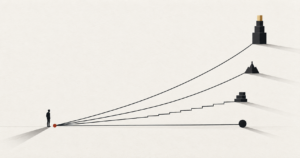
Three levels, one test
There is a progression most founder-led businesses move through, and the cleanest way to see where you sit is not revenue. It is what your absence does.
At the first level, you are the work. You are delivering, selling, fixing, invoicing. Step away and nothing happens, because you were the thing happening. Fine when you are starting. A trap when you are still there three years later.
At the second level, you have hired people, but you are still the router. The work can happen without you doing it, but not without you directing it. Every decision of consequence waits for you. Step away and the machine idles, engine running, nobody touching the gears.
At the third level, your absence is when the strategic work actually gets done. The delivery runs without you. The decisions have owners who are not you, and the highest-value thinking, the positioning, the direction, the place where the real bottleneck sits, does not need your desk. It needs your head, and your head works better away from the noise.
Most founders assume the third level is about hiring better people. It is not. It is about building a business that does not depend on any one person being in the room, and then having the nerve to leave the room.
What stepping away actually taught me
I have done this deliberately more than once. Not as a reward for building the business, but as the way I built it.
In 2016 I went to the Do Lectures in West Wales. Three days on a farm in Cardigan where people who have done truly amazing things stand up and talk about how and why. No stage-managed keynotes. No sponsor booths. Just people, ideas and time to think.
I went on my own. I knew nobody. That is not a natural setting for me. Rocking up solo to three days with a cow shed full of strangers is exactly the kind of thing I would normally engineer my way out of. I made myself go precisely because it was uncomfortable.
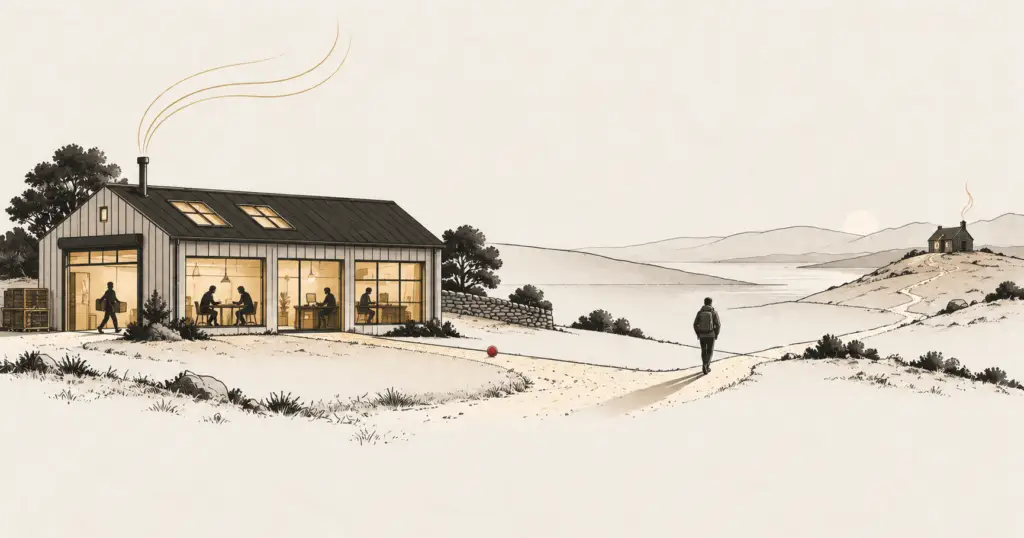
Two years later I did it harder. 2018, Walking, Whisky, Wellness in Aviemore. Three days in the Cairngorms in Scotland. Long walks, talks, and evenings around a fire with strangers. I had three nights alone in a bothy, which if you have never stayed in one, is a solitary hut with no electricity, no room service, no distraction. Just you, the weather and your own head.
That kind of silence is confronting when you are used to a full calendar. But it is also where things get clear. Problems I had been circling for months untangled themselves in the space where nothing was pinging at me. Not because I worked harder on them. Because I finally had room to see them properly.
Here is the commercial point, though, and it is the one I would want you to take rather than my travel diary. Every time I put myself somewhere new, among people who did not know my usual answers, I came back with sharper thinking about the business, not weaker. The distance was not time off from the strategic work. It was the strategic work.
Most founders have this backwards. They treat thinking time as the reward for getting through the doing. It is the other way round. The doing is what you delegate. The thinking is the bit only you can do, and it almost never happens at your desk.
The lesson that reshaped how I build things
There is an older story that taught me the same thing from a different angle.
Back in 2013, a Welsh journalist called Lynne Allbutt approached me with an unusual request. She wanted to become the first person to run across Wales barefoot, that is 51 miles in two days with no shoes on, and she wanted help making it happen. So my young team and I took it on. We built the websites, ran the campaigns, managed the social, and chivvied her along for six months until she did it in 2014.
None of that was our core business. On paper it was a distraction from fee-earning work.
But my team learned more from that project, real copywriting, real campaign management, real content, real coordination under a real deadline that mattered to someone, than they would have learned from any classroom course I could have sent them on. Lynne captured it in her book, “Barefoot and Before”, which I was proud to write the foreword for. Her own words were:
“Tom works on the premise that these real-life projects are an effective way for his staff to learn new skills in fun and engaging ways as opposed to sending them away on conventional courses.”
That is the transferable lesson, and it applies directly to a founder-led business. The capability you actually need, people who can think, decide and deliver without you standing over them, does not get built by sending them on a course or writing a process document. It gets built by handing them something real, with a real outcome attached, and stepping back far enough that they have to own it. Every time you step in to “just check”, you rob them of the exact experience that would let you step away for good.
Stepping away and building capability are not two separate goals. They are the same move. You cannot do one without the other.
The uncomfortable version of the question
My own book manuscript poses it more bluntly than I usually would in a first conversation.
Could this business be sold tomorrow, with the founder walking away, and continue delivering excellent results?
If yes, you have built something resilient.
If no, you have built a job that looks like a business.
Most founders do not want to run that test, because they already suspect the answer. The checking on holiday, the pipeline that stalls, the team that waits, they are all the same signal. The business runs on you, not on infrastructure. And a business that runs on you has a ceiling, because you have a finite number of hours and a genuine need to occasionally sit by a fire, or walk a hill, or look at the sea without your phone in your hand.
The good news is that this is fixable, and it is a commercial problem, not a personal failing. The bottleneck is not that you are not working hard enough. It is usually that the commercial architecture, how the business wins work, makes decisions and moves forward, was never built to run without you. So of course it does not.
You do not fix that by working harder. You fix it two ways at once. You build capability into the people around you by giving them real ownership, not supervision. And you give yourself the distance to do the thinking only you can do. Then, occasionally, you step away entirely, and let the business prove it can run without you.
Somewhere with no wifi, ideally.
Frequently Asked Questions
How do I stop being the bottleneck in my own business?
Give decisions owners who are not you, move the commercial knowledge out of your head into documented positioning, process and playbooks, and hand your team real projects with real outcomes. Then step back far enough that they have to own them. Every time you step in to just check, you remove the experience that would let you step away for good.
What is the absence test for a founder-led business?
The absence test asks what your business actually does when you step away for a couple of weeks, rather than judging it by revenue. If the pipeline stalls, the team waits and every decision routes back to you, that is a structural signal about how the business is built, not a scheduling issue. A business that keeps making decisions and delivering in the founder’s absence is operating at a fundamentally different level from one that idles the moment the founder goes dark.
What are the three levels a founder-led business moves through?
At the first level, the founder is the work, delivering, selling and fixing, so nothing happens when they step away. At the second level, the founder has hired people but is still the router, meaning work can happen without them doing it but not without them directing it, so every decision of consequence waits. At the third level, delivery and decisions have owners who are not the founder, and the founder’s absence is precisely when the highest-value strategic thinking gets done.
Is building a business that runs without you about hiring better people?
No. Reaching the level where a business runs without the founder is not primarily about hiring better people. It is about building a business that does not depend on any one person being in the room, then having the nerve to actually leave the room. Capability is built by handing people something real with a genuine outcome attached and stepping back far enough that they have to own it, not by supervision or by sending them on a course.
Why is stepping away part of the strategic work rather than time off from it?
Most founders treat thinking time as the reward for getting through the doing, but it works the other way round. The doing is what you delegate; the thinking, positioning, direction and identifying the real bottleneck is the part only the founder can do, and it rarely happens at a busy desk. Distance and silence create the room to see problems properly, so putting yourself somewhere new tends to produce sharper commercial thinking, not weaker.
How do you build capability so a team can decide and deliver without the founder?
Capability comes from giving people real ownership rather than supervision. Hand them a project with a real outcome that matters to someone, then step back far enough that they have to own it and deliver under a deadline. Every time the founder steps in to just check, they remove the exact experience that would let them step away for good. Stepping away and building capability are the same move, not two separate goals.
What is the cost of a business that only runs when the founder is present?
A business that runs on the founder rather than on infrastructure has a hard ceiling, because the founder has a finite number of hours. The blunt version of the test is whether the business could be sold tomorrow, with the founder walking away, and continue delivering excellent results. If yes, it is resilient; if no, the founder has built a job that looks like a business. It is a commercial architecture problem, fixable by building ownership into others and protecting thinking time, not a personal failing solved by working harder.