When buyers compare you on price, it is almost never because your price is wrong. It is because your proposition has not given them any other way to choose. When a buyer cannot tell what makes you different from the firm next to you, price becomes the only variable left to decide on, and the cheapest option wins by default. This is one of the most expensive problems in professional services, and it is a positioning problem dressed up as a pricing problem. The good news is that it is fixable, and the fix does not involve dropping your rate.
This post explains the pattern behind it, why it quietly destroys margin, and the four shifts that move you out of the price conversation for good.
The real reason you keep ending up in a price war
There is a specific failure pattern at work here. I call it the Comparison Trap: when differentiation is weak, buyers are forced to compare on price, the cheapest option wins, and margin disappears. It is not that your buyers are cynical or only care about cost. It is that you have not given them a reason to weigh anything else.
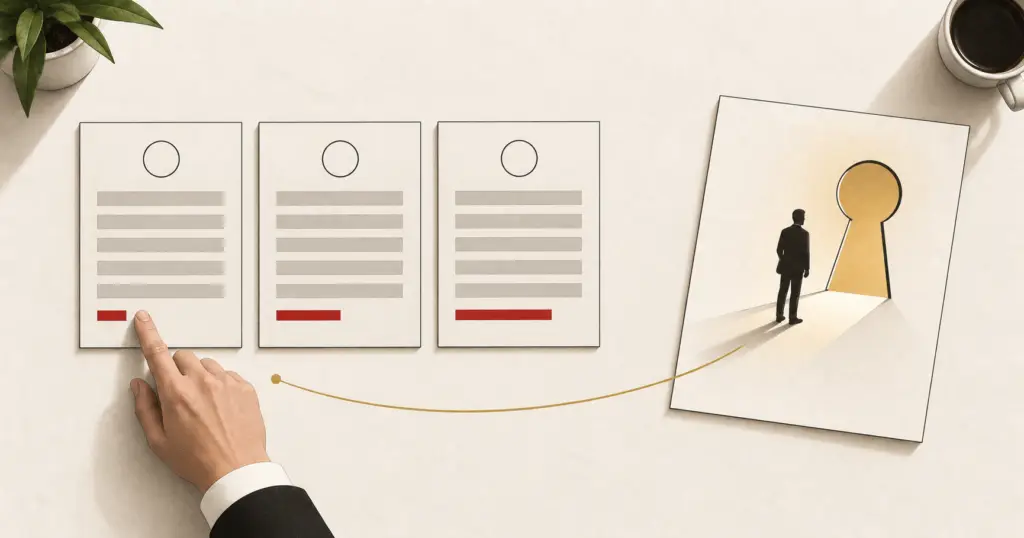
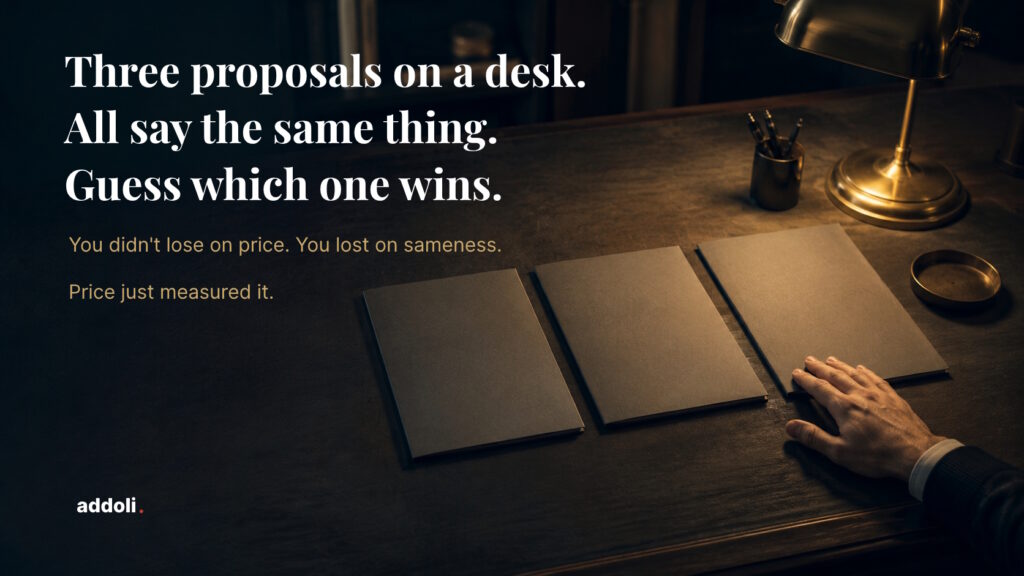
Picture a buyer with three proposals on the desk. All three describe similar services. All three use similar language. All three list capabilities and logos. From the buyer’s chair, these firms are functionally identical. So what is a rational buyer to do? They look at the one number that differs between them. Price becomes the tie-breaker because you have left it as the only thing that can break the tie.
You did not lose on price. You lost on sameness, and the price was simply where that sameness was finally measured.
Why “we’re different” doesn’t rescue you
Every firm believes it is different. Most say so on their website. The problem is that the differences they name are ones the buyer cannot use to decide. “We’re experienced.” “We’re trusted.” “We take a partnership approach.” “We’re client-focused.” Every competitor says exactly the same things, which means none of them differentiate anyone. The buyer cannot act on a claim that everybody makes.
There are four patterns that quietly push buyers toward price. Recognising which one you are caught in tells you what to fix.
The Mirror Trap
Your proposition reflects you, not the buyer. It describes your capabilities, your methods, your services, your team. The buyer has to translate all of that into “can this help my problem,” and many will not make the effort. A proposition that talks about the seller leaves the buyer with nothing to grip except price.
The Wrong Invite
Your positioning casts too wide a net. By trying to appeal to everyone, it resonates with no one in particular. The right-fit buyer does not see themselves clearly enough to feel “this firm understands my exact situation,” so they treat you as a generalist among generalists, judged on cost.
The Trophy Cabinet
You display proof but do not narrate it. Logos line the page. Client names are listed. But there is no story: no before, no after, no outcome, no stakes. Displayed proof impresses for a second and persuades for none, because it creates no belief that you will change anything. Without belief in the outcome, the buyer falls back on price.
The Comparison Trap
The cumulative result of the three above. Weak differentiation forces a like-for-like comparison, and the only axis left is cost.
How to make buyers stop comparing you on price
The escape is not a clever pricing tactic. It is rebuilding the proposition so the buyer has richer grounds to choose. Four shifts do most of the work:
1. Lead with the buyer’s problem, not your capability
Stop opening with what you do. Open with the specific, must-fix problem your best-fit buyer is stuck on, named precisely enough that they think “that is exactly my situation.” When a buyer recognises their own problem in your words, attention sharpens immediately and you stop being interchangeable. This is the difference between “we provide commercial consulting” and naming the precise commercial bottleneck a specific buyer is wrestling with right now.
2. Get specific enough to be unmissable to the right buyer
Vague positioning protects you from rejection but also from selection. Narrow your proposition to one buyer, one problem, one moment. The fear is that you will exclude people. The reality is that precision is what makes the right people lean in. A buyer who sees their exact situation described will choose the firm that clearly understands it over a cheaper generalist, because the perceived risk of getting it wrong outweighs the saving.
3. Narrate your proof, don’t just display it
Replace the logo wall with outcomes. For each piece of proof, tell the short story: what the situation was, what was at stake, what you did, and what changed. A narrated outcome creates belief that you will produce a similar result. Belief in the outcome is what lets a buyer justify paying more than the cheapest option, because they are no longer buying a service, they are buying a result they can picture.
4. Name your method so the value is visible
When every engagement looks bespoke and improvised, buyers cannot see what they are paying for, so they default to comparing the price of the inputs. Give your approach a name and a clear set of steps. A named, repeatable method signals that you have solved this problem many times before, that the outcome is reliable, and that there is real intellectual property behind the fee. It moves the conversation from “how much per day” to “what does this method deliver.”
The mindset shift underneath all of this
The shift is from “what we do” to “why clients choose us.” Selling capabilities builds sameness, and sameness builds price competition. Selling a proposition, one that is specific, buyer-led, proven through narrated outcomes and delivered through a named method, builds the kind of differentiation that takes price off the table. You are no longer one of three interchangeable options on a desk. You are the firm that visibly understands the problem and can be trusted to fix it.
Price stops being the deciding factor the moment you give the buyer something more important to decide on.
Frequently Asked Questions
Why do buyers keep comparing my business on price?
Because your proposition has not given them any other way to choose. When three proposals describe similar services in similar language, price is the only difference left, so the cheapest option wins by default. It is a positioning problem that shows up as a pricing problem.
Why do clients always try to negotiate my price down?
Usually because your proposition has not given them another way to choose between you and a competitor. When differentiation is weak, price becomes the only variable left, so buyers push on it. Strengthen the proposition and the pressure on price eases.
How do I stop competing on price in professional services?
Shift from describing your capabilities to naming the buyer’s specific problem, narrow your positioning so the right buyer recognises themselves, narrate your proof as outcomes rather than logos, and give your approach a named method. Together these give the buyer reasons to choose you beyond cost.
What is the Comparison Trap?
The Comparison Trap is a positioning failure where weak differentiation forces buyers to compare firms on price. The cheapest option wins and margin disappears. The cause is sameness in how firms describe themselves, not the buyer’s preferences.
Will being more specific lose me clients?
It will filter out poor-fit enquiries, which is the point. Precise positioning makes the right buyers lean in because they see their exact situation described, and they will often choose a clearly relevant firm over a cheaper generalist.
Is competing on price ever the right strategy?
For commoditised, undifferentiated offerings, scale and cost leadership can work. For founder-led service firms selling expertise, competing on price erodes the margin that funds quality, and it is usually a symptom of a proposition that has not done its job rather than a deliberate strategy.
I have also designed several free commercial diagnostic tools that you can take right away. Just click on the link below and complete them to get an instant report.
I look forward to meeting you.
Tom