
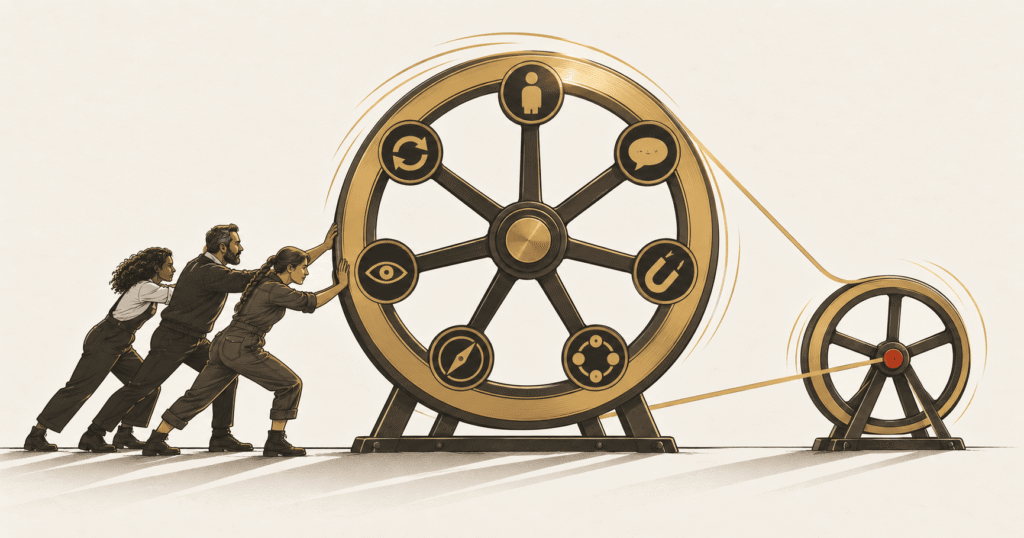
In a world of scattered campaigns, disconnected tools, and ad hoc marketing strategies, too many businesses still chase leads instead of building momentum. The result? Teams waste hours juggling reports, managers are frustrated by unclear ROI, and service delivery becomes reactive rather than strategic. That’s exactly the problem the Lead Gen Flywheel was designed to solve. The Lead Gen Flywheel is a core part of Addoli’s commercial framework that we undertake with new clients.
The Problem with Linear Marketing
Traditional marketing funnels treat campaigns like a one-way trip: attract, convert, close. But what happens next? Once the campaign ends, momentum stops. You start from scratch again with every new launch, every new audience, every new offer.
It’s exhausting.
Your team spends hours manually compiling reports, toggling between platforms, and debating what “worked.” Campaigns feel like sprints rather than systems, each one disconnected from the last.
The Flywheel replaces this start–stop approach with a continuous system of learning, optimisation, and momentum, one that doesn’t just generate leads but compounds results over time.
What the Lead Gen Flywheel Is (and Why It Works)
At its core, the Lead Gen Flywheel is a framework for structuring marketing campaigns and product or service promotion around measurable progress, audience insight, and strategic focus.
Instead of chasing every persona or promise at once, the Flywheel forces clarity:
- One person
- One problem
- One promise
That focus allows you to craft messaging that’s concise, relevant, and resonant. You identify a specific buyer persona, your main target, and build your campaign around their specific problem and the transformation your product provides.
Once that message starts gaining traction, you build velocity, momentum that carries into your next persona and campaign layer. Each turn of the wheel compounds results, rather than starting over.
Step One: Identify and Understand Your Persona
Most marketing goes wrong at the starting line. Without a deep understanding of who you’re speaking to, even the best creative or offer will miss.
The Flywheel begins with buyer persona clarity, knowing the fears, frustrations, wants, and aspirations of your target audience. For example:
- The Daily Platform User wants ease of use and time savings.
- The Manager needs efficiency, insights, and measurable progress, with easy to generate reports.
- The Fee Payer cares about ROI and business outcomes.
Each campaign starts with empathy and ends with evidence, proof that your product or service directly solves the pain your persona experiences every day.
Step Two: The Promise and the Premise
The Promise is your magnetic value proposition, what your audience gets when they choose you. The Premise is your acknowledgment of their skepticism.
People don’t buy features; they buy outcomes. But they also buy from brands that understand their doubts. Instead of resisting skepticism, the Flywheel encourages you to address it head-on.
For instance:
“We know you’ve tried other platforms that overpromised and underdelivered. That’s why our system combines proven software with coaching and community, so your team doesn’t just get tools, they get transformation.”
This direct approach disarms objections and builds trust.
Step Three: Differentiate with Structure and Style
Your competitors might offer “fast, easy, reliable” solutions, but so does everyone else.
The Flywheel helps you uncover your unique difference by examining your strategy, structure, systems, shared values, and style:
- Strategy: How you think differently.
- Structure: How your business model delivers results.
- Systems: The processes that make your promises repeatable.
- Shared Values: What you and your customers both care about.
- Style: How your brand expresses itself and guides clients to the “Aha!” moment.
This exercise creates a consistent story across campaigns, one that reinforces your identity every time the wheel turns.
Step Four: Build Market Intimacy
Flywheel marketing is built on feedback loops. Every campaign should deepen your understanding of the market, what mistakes your prospects make before using your product, what results they achieve afterward, and how quickly their insight, confidence, and performance increase.
For example:
“Before using our system, clients spent hours manually tracking performance data. Within a month, they reclaimed 3+ hours per week and finally had real-time insights to make faster, smarter decisions.”
These insights fuel your next campaign. The better you understand your market, the faster your Flywheel spins.
Step Five: Reinforce with Positioning and Purpose
Your positioning statement is your brand’s reason for existence. It’s where your values and your customers’ goals intersect.
“That’s why we… built a system that helps teams move from firefighting to forward planning.”
Every message, landing page, and ad should circle back to this foundation. It’s not about selling another product, it’s about reinforcing a promise that your audience can believe in, again and again.
Step Six: The Cost of Doing Nothing
Inaction is your competition. The Flywheel framework asks a critical question: What happens if your customer does nothing?
When you can articulate the cost of inaction, lost hours, wasted potential, missed opportunities, you create urgency and relevance without resorting to hype.
It’s not about fearmongering; it’s about making the consequences of stagnation visible.
Step Seven: Keep the Wheel Spinning
Once you’ve nailed one campaign, one persona, one promise, don’t stop. Use the insights, performance data, and refined messaging to power the next rotation. Over time, the Flywheel becomes a self-sustaining ecosystem that unites campaign management, content strategy, and service delivery into one cohesive motion.
That’s when marketing stops feeling like guesswork and starts feeling like momentum.
The Bottom Line
Campaigns that aren’t structured around a system inevitably fade and show little return on investment. The Lead Gen Flywheel gives your marketing perpetual motion, turning insight into improvement, and improvement into results.
It’s not just about generating leads.
It’s about generating learning.
And when your marketing learns faster than your competitors’, growth becomes inevitable.