
Most founders I work with can tell you their revenue figure. Very few can tell you why it isn’t higher.
Not for lack of trying. They’ve hired people, adjusted their pricing, run marketing campaigns, attended networking events, refined their pitch. Some of this has worked, temporarily. None of it has broken the ceiling.
The reason is that they’re applying solutions to the wrong problem. And they’re applying the wrong solutions because they haven’t correctly diagnosed which stage of growth they’re actually at.
The 7 Plateaus Framework exists to fix that.
What the Framework Is
The 7 Plateaus is a commercial maturity model. It maps the journey of a founder-led business from startup to market leader across seven distinct stages. Each stage has its own commercial constraints, its own leadership challenges, and its own set of infrastructure requirements.
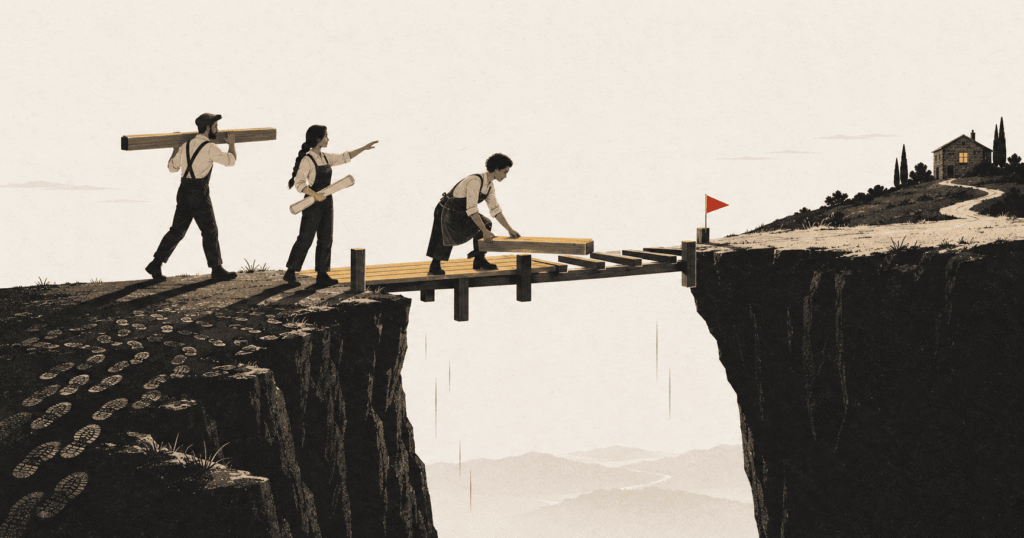
The insight at the centre of the framework is this: what gets you from one plateau to the next is not more effort applied to what’s already working. It’s different architecture: different systems, different structures, different approaches, appropriate to the stage you’re moving toward.
Applying Plateau 4 solutions to a Plateau 2 problem doesn’t accelerate growth. It creates confusion and wasted resource. Applying Plateau 2 solutions when you’re actually at Plateau 3 keeps you stuck, because you’re working harder at an approach that has already reached its ceiling.
The Seven Stages
Plateau 1: The Starting Line
Revenue: pre-revenue to approximately £500k. The central question: ‘Will this actually work?’ The constraint is validation, not scale. The founder is doing everything. Nothing is systematised because nothing is proven yet. This is appropriate, systematising before you have product-market fit is premature.
Plateau 2: First Proof
Revenue: £500k to approximately £1.5m. The central question: ‘It’s working, but it’s fragile.’ Revenue is coming in, primarily through founder relationships and early reputation. The constraint is repeatability. The business works, but it depends almost entirely on the founder. Removing them for two weeks (or longer) would cause serious damage.
Plateau 3: The Busy Trap
The central question: ‘We’re growing, but everything depends on me.’ This is where most businesses that have ‘made it’ get stuck. The delivery is strong. The team is capable. But the commercial engine (positioning, pipeline, sales process) is still essentially the founder. Deals close because of founder involvement. Proposals get written when the founder has capacity. Growth is constrained by what one person can handle.
Plateau 4: Almost There
The central question: ‘We need systems, not just effort.’ The leap from Plateau 3 to Plateau 4 is the most significant in the framework, and the most commonly failed. It requires building commercial infrastructure that operates independently of the founder: documented sales process, issue-led positioning, systematic pipeline management, qualification frameworks. Most founders attempt this leap by hiring rather than by building systems. The hire fails because the infrastructure doesn’t exist to support them.
Plateau 5: The Engine Room
The central question: ‘Growth is real, but the organisation is straining.’ The commercial engine works. The constraint has shifted to organisational infrastructure: management structure, reporting, decision-making authority, internal communication. The founder is still doing too much, but now it’s operational rather than commercial decisions that are bottlenecking.
Plateau 6: The Incomparable Business
The central question: ‘We’re good, but the market doesn’t know it.’ The business has strong capability and functioning infrastructure. The constraint is market visibility and perceived distinctiveness. The business is winning work from existing relationships but struggling to grow beyond its current network. Positioning, thought leadership, and visible authority become the primary commercial levers.
Plateau 7 : Category Ownership
The central question: ‘We own our space.’ The business has a recognised position in its market. It attracts inbound opportunities. The brand precedes the conversation. The constraint is sustaining and defending the position while managing organisational complexity at scale. You’re open to market disruption if you become complacent.
Where Most Businesses Get Stuck
From my conversations with founders and leadership teams, it is apparent that the majority of founder-led businesses in the £1m–£15m range are stuck between Plateau 3 and Plateau 4.
They have operational capability. Delivery is strong. The team can handle the work. But the commercial infrastructure, the systems and structures that would allow the business to grow beyond the founder’s personal capacity, either doesn’t exist or was built hastily and hasn’t held.
The most common misdiagnosis: founders at Plateau 3 believe they have a sales problem. They hire sales capability to solve it. The hire fails because the problem isn’t sales capability, it’s commercial infrastructure. The salesperson has no positioning to sell, no process to follow, no pipeline discipline to operate within. They’re set up to fail.
How to Diagnose Your Plateau
The diagnostic questions below are designed to identify which plateau you’re currently at. Answer honestly, the value of the exercise depends on it.
On positioning: Can every member of your team articulate precisely what problem you solve, for whom, and why your approach is different? If the answer is ‘sort of’ or ‘it depends who you ask’, you haven’t crossed the Plateau 3/4 boundary.
On pipeline: Can you forecast revenue three months out with reasonable confidence, without the forecast being based primarily on relationships and optimism? If not, the pipeline infrastructure isn’t built.
On founder dependency: Could your business run at full commercial capacity for four weeks without your direct involvement? If the honest answer is no, you’re at Plateau 3 regardless of your revenue figure.
On sales process: Is there a documented process that any competent person could follow to take an opportunity from first conversation to closed deal? Or does the process live primarily in the founder’s head?
If you answered ‘no’ to most of the above, you’re at Plateau 3, and the work is infrastructure, not activity.
The Fix Sequence
Step 1: Accept that effort alone won’t break this plateau
This is the hardest step because it contradicts everything that got you here. The business reached Plateau 3 through effort, relationships, and founder capability. The belief that more of the same will get you to Plateau 4 is understandable and wrong. The constraint isn’t effort. It’s architecture.
Step 2: Diagnose the specific constraint
Within the Plateau 3/4 gap, there are usually three to five specific constraints operating simultaneously. Positioning is unclear. Pipeline is unstructured. The sales process is undocumented. The founder is in every commercial decision. Identifying which of these is the binding constraint, the one that, if fixed, would free up the others, is the starting point for effective intervention.
Step 3: Build infrastructure in the right sequence
The correct build sequence for most businesses at Plateau 3: positioning first (what do we sell and to whom?), then pipeline structure (how do we manage opportunities?), then sales process (how do we progress deals?), then team enablement (how do we get the team operating the system independently?). Skipping steps or reordering them is the most common reason commercial infrastructure projects fail.
If this resonates with you, let’s talk.
Frequently Asked Questions
Why has my B2B business stopped growing at around £2m to £5m revenue?
Usually because growth still depends on the founder. The commercial engine, meaning positioning, pipeline and the sales process, was built around one person’s relationships and time. When that person’s hours are full, revenue flattens, whatever the market is doing.
Is a growth plateau a sales problem?
Rarely. Most founders at Plateau 3 diagnose a sales problem and hire a salesperson. The hire fails because there is no positioning to sell, no process to follow and no pipeline discipline to work within. The constraint is commercial infrastructure, not sales capability.
How do I know which plateau my business is on?
Ask four questions. Can every member of your team explain what problem you solve, for whom and why you? Can you forecast revenue three months out without relying on relationships and optimism? Could the business run at full commercial capacity for four weeks without you? Is there a documented sales process any competent person could follow? If most answers are no, you are at Plateau 3. The free 7 Plateaus Assessment confirms it in 5 minutes.
How do I get past a growth plateau?
Stop adding effort to the same approach. Diagnose the specific constraints, usually three to five operating at once, such as unclear positioning or a sales process that lives in the founder’s head. Then build the commercial infrastructure in sequence: positioning first, the sales process second, and a pipeline system that runs without you third.