

Introducing Stakeholder Mapping: The Must Have Strategy Tool
Tom Wood, Founder, Addoli
3rd November 2025 | 4 Minute Read
If your strategy conversations keep circling around cost-cutting, org charts, and we need more sales, you’re not alone. Many leadership teams confuse operational improvement with strategy, then wonder why performance and sales plateau. The missing link is often a clear view of who actually drives your success and what they truly need from you. That’s where stakeholder mapping comes in. It’s the discipline of identifying your true key stakeholders, clarifying what they want, and then aligning your objectives and choices to win with them, driving focused performance gains.
What is Stakeholder Mapping?
Stakeholder mapping is a structured way to plot the groups that have a fundamental impact on your organisation’s performance (e.g., customers, employees, suppliers, owners/investors, regulators, partners), and to articulate the few things you must get right for each of them to succeed together. Crucially, you don’t stop at a single, generic list of “critical success factors.” You develop one set per stakeholder group, because what matters to customers is not the same as what matters to employees or suppliers, etc, and strategy must be anchored in those differences.
This is a sharp break from those traditional bland lists that tend to be internally generated, broad, and difficult to measure: Think how many times have you seen an objective like, “enhance relationships,” “improve processes,” “promote collaboration”, and you will catch my drift. Those lists feel like you’re not focusing on the end goal, and they rarely create competitive advantage, wasting precious time and resources. They also leave staff trying to second guess what they’re meant to do.
Stakeholder mapping replaces that one-size-fits-all list with targeted, validated factors for each stakeholder, defined from their point of view. An independent view is often the differentiator, forcing you to think in a more focused way.
Why Stakeholder Mapping Matters for Strategy Planning
- It clarifies strategy vs. operations. Cost-cutting, random lead generation, and process tweaks are operational choices. Strategy is about the planned positions you take on stakeholder-valued factors. Stakeholder mapping forces that distinction and gets leaders and Boards debating the right trade-offs. It’s a positive movement that gets everyone involved and bought in.
- It focuses scarce effort. Not all stakeholders are “key.” Make sure you focus on the right ones, and if they are not considered ‘key’, then take them off the list. This helps you concentrate resources where advantage is actually built.
- It builds measurable objectives. When you name the behaviour you want from each stakeholder, you can write proper objectives with real measures and targets. A simple discipline to set proper metrics that leaders can run the business with, and that all your staff understand.
- It aligns the business model. Mapping the transactions and exchanges between you and each stakeholder reveals your actual business model, and where it must evolve over the next 3–5 years. It becomes far easier to agree the “current vs. future” picture and to prioritise strategic moves.
Stakeholder Mapping: How It Works (Fast)
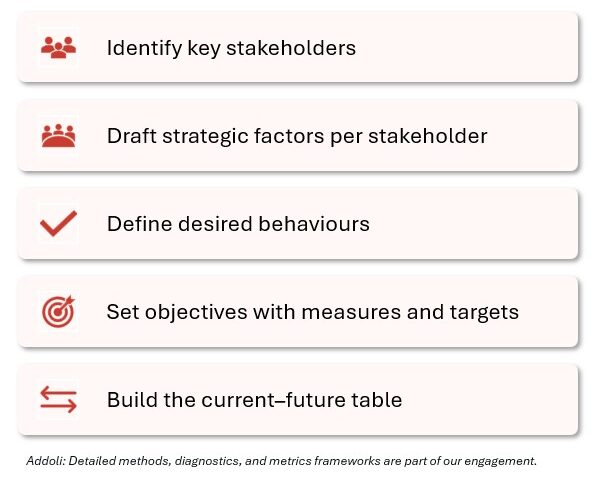
What You’ll Notice In Practice
- Sharper choices. When you see, for example, that customers prize turnaround and price simplicity, while employees prize development and recognition, your strategic planning looks different, and smarter.
- Cleaner governance conversations. Boards stop debating woolly KPIs, and start asking, “Are we improving against the stakeholder’s metrics, and are our objectives and results showing it?”
- Healthier targets. Setting realistic, credible goals (not internal “stretch” fantasies) creates capacity to invest in the right areas for the long term.
- More focused teams. When everyone truly understands what is expected of them, and they are all pulling in the same direction, then results will happen.
Pitfalls To Avoid
- One generic list. If you have one consolidated set of metrics for the whole company, you’ve likely collapsed stakeholder needs into confusion. Split by stakeholder, or you’ll design to nobody.
- Inside-out bias. Drafts made in a workshop are hypotheses. Don’t let groupthink creep in. Validate with independent challenge, stakeholder interviews and reviewing your data.
- Unmeasurable goals. If an objective can’t be measured, then it’s not an objective; it’s a wish.
Stakeholder mapping is a key part of developing your strategy. Done properly, it will force the conversations that actually change outcomes: who we’re targeting, what they value, which behaviours we need, and how we’ll measure progress. Do that well, and the rest of the plan gets a lot simpler, and a lot more effective
Work With Addoli