
This week I sat in on a lunchtime webinar about AI and customer experience. The question being debated was a familiar one: just because we can automate something, should we?
It’s a good question. But it starts in the wrong place.
The better starting point is narrower and harder to dodge: what’s actually broken, and why?
Most customer service today isn’t a service. It’s a repair job, the endless fixing of things that should never have gone wrong in the first place. And almost every time, the breakage didn’t start with the customer. It started upstream, with a decision made by someone who never has to deal with the consequences of it.
That’s not an AI problem. That’s a design problem.
AI can genuinely help. It can clear the upstream mess so the human part of the relationship gets the space it needs. But automation only fixes a broken system if someone first admits the system is broken. Otherwise, you’ve just made the breakage faster.
I see the same pattern across commercial businesses, and it’s rarely about technology. It’s about trust, and whether the system you’ve actually built lets trust exist, or just talks about it.
The hire I almost didn’t think to make
Twenty-plus years ago I was working at a startup, learning how to build a business: process design, and what good (and bad) digital experiences looked like. One of the people there, Paul, became one of the most important professional relationships of my career, though I didn’t know that yet.
He was smart, detail-oriented, and had a gift for turning messy situations into structured, understandable systems. He taught me how to use Excel properly: not as a calculator, but as a real analytical tool. How to build reports that told you something. How to track metrics that mattered, rather than metrics that were just easy to measure.
When my father called me to come and build out the business, the first thing I did was bring Paul with me. You hang on to the good people.
We built the e-learning platform and the compliance consultancy together in a cold storage room above a shop in Blaenavon. No carpets. Boxes everywhere. I worked from a borrowed optician’s chair because it was too heavy to move.
He trusted my vision from day one. I trusted his judgement from day one. Neither of us had much evidence yet that the other one was right. We just decided to operate as if we were.
That decision is the entire story of what came next.
Paul went on to head up service delivery. To this day he gets phenomenal feedback from clients, not because he’s flashy, but because he’s thorough, reliable, humble, and genuinely committed to getting it right. Thousands of people across the insurance industry know him as the person who sorts things out: their CPD, their team structures, their monthly reports, their password resets, the problems other people don’t prioritise to fix properly.
I never checked his work. I didn’t need to. The system was built deliberately, from those first weeks in the cold storage room, so that his judgement could move freely. That’s the whole game. Not that I hired someone good. That I built something where good judgement didn’t have to ask permission to be used.
I caught up with Paul again recently, back in Wales. Same trust, near enough two decades on.
Service isn’t a soft cost. It’s your sharpest differentiator.
Here’s the part that gets missed when people talk about culture and trust as if they’re just nice things to have.
Knowing Paul would deliver, every time, without me checking, wasn’t just good for my stress levels. It was a commercial asset, a genuinely sellable one.
Once you know your service quality is real and repeatable, you’ve got something most of your competitors don’t: a differentiator that isn’t a feature on a specification sheet. Anyone can claim “exceptional service” in a pitch deck. Almost nobody can back it with eighteen years of a named person delivering it consistently enough that clients remember his name, not just the company’s.
That’s not a soft asset. That’s the hard evidence base your sales conversations are built on. The testimonials. The renewal rates. The referrals that arrive without you asking. The case studies that write themselves because the work held up on its own. None of that exists if the service was inconsistent. You can’t build proof on something you have to apologise for.
And it changes what you’re selling. You’re not selling a promise the founder has to personally guarantee on every account. You’re selling a system that delivers the promise whether or not you’re in the room. That’s a fundamentally more valuable thing to put in front of a buyer, the difference between a business that can only grow as fast as the founder can vouch for every client, and one that can scale its credibility alongside its client base.
Most founders treat service quality as an internal operational concern. It isn’t. It’s commercial infrastructure, and it belongs in the same conversation as pricing and positioning, because it’s doing the same job: making you easier to say yes to, and harder to walk away from.
Where the gap actually shows up
Most founders will tell you they want what Paul and I had. Empowerment. Autonomy. People who own decisions instead of waiting to be told what to do.
Then someone on the team makes a call the founder would have made differently, and the founder overrules it, quietly, reasonably, with a perfectly good explanation. And the empowerment they said they wanted stops being real, right there, in that one decision.
Your people feel it the moment it happens. They don’t need it explained. They experience the gap between what you said the culture was and what the culture actually does, and they adjust accordingly:
- With customers, your people hesitate. They can’t commit to anything without checking the policy or checking with you first. So they under-promise, move slowly, and ask permission instead of solving the problem in front of them. Good customers feel that hesitation, and over time some of them leave.
- With retention, your best people don’t quit loudly. They quietly downgrade. They do the minimum required, because somewhere in year two they worked out they were right not to fully trust the system — and once that calculation is made, it’s rarely unmade.
- With decision speed, every choice that has to wait for you, or for the next meeting, is a choice your market is making faster than you are. Your competitors don’t have the same bottleneck, even with a worse product.
- With ideas, people stop bringing you the ones they think you’ll reject. What you get instead is compliance dressed up as alignment, an echo chamber that nods along, not people genuinely thinking with you.
None of this is because your people lack judgement. You hired them because they had it. The gap exists because you built a system where that judgement can’t be used without your permission, and then wondered why growth slowed down.
That’s not culture. That’s theatre with a culture deck.
The bottleneck with better branding
This is also, not coincidentally, what founder burnout really is. Not a calendar problem. An infrastructure problem.
When every meaningful decision, (hiring, pricing, a customer escalation, a partnership), has to flow through one person, the business can only move at the speed that person’s brain processes information. On a good week, that’s slow. On a bad week, when you’re exhausted and stretched and the thing you most need is for other people to handle things, it’s close to zero.
That’s not leadership. It’s a bottleneck with better branding.
And it’s rarely fixed by hiring more ambition into the room. Growth stalls in founder-led businesses not because the team doesn’t want to grow the company, but because they’re sitting on decisions they’re entirely equipped to own, waiting for a green light only one person can give.
Trust isn’t a value. It’s an architecture.
Here’s the thread running through all of it: the webinar, Paul, the culture gap, the bottleneck.
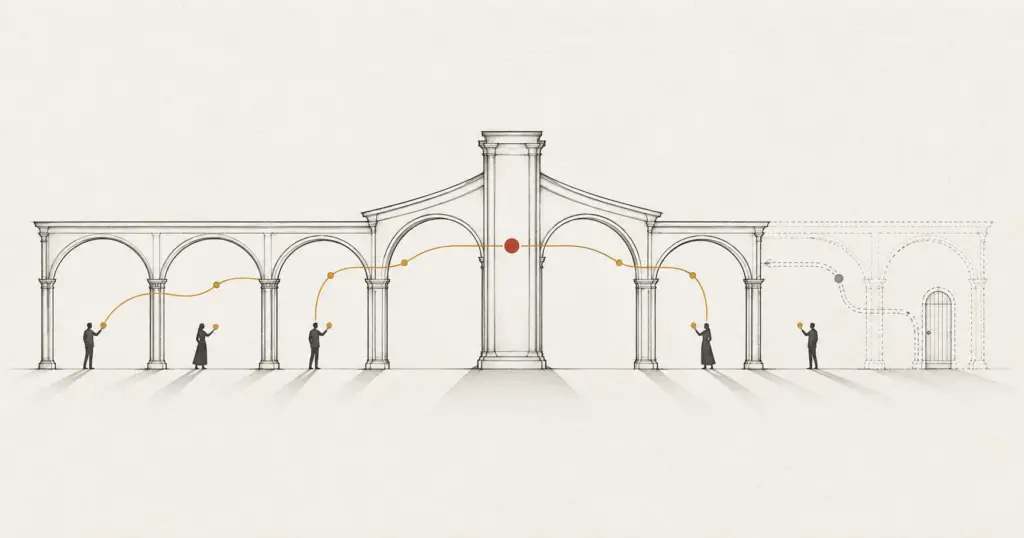
Trust isn’t something you state in a values deck. It’s something you build, decision by decision, into the actual architecture of how the business runs. Who can decide what, without asking. What happens when someone’s judgement turns out to be different from yours. Whether the system extends trust outward through the organisation, or quietly pulls it back to the centre every time it matters.
When you get that architecture right, it doesn’t just reduce your stress. It becomes something you can put a price on. Consistent, trusted delivery is proof you can point to in a pitch, not a hope you ask buyers to take on faith. Most founders are sitting on more of that proof than they realise, they just haven’t built the system that lets it show up reliably enough to sell.
AI doesn’t change this calculation. It removes the cover. A business with no real decision-making architecture used to disguise that with effort: more hours, more checking, more founder availability. AI strips that disguise away fast. The places where trust was never actually built become visible, and expensive, very quickly.
So the real audit isn’t “what do we believe?” It’s narrower and harder to dodge:
Where in your system does someone’s good judgement get overruled, second-guessed, or routed back to you – and what is that actually costing you? In the customers who feel the hesitation before they ever say anything. In the people who quietly stop bringing you their best thinking. In the growth that’s sitting there, unclaimed, because it’s waiting on a decision only you’re allowed to make.
If you don’t know the answer to that, that’s usually where the real diagnostic work starts.