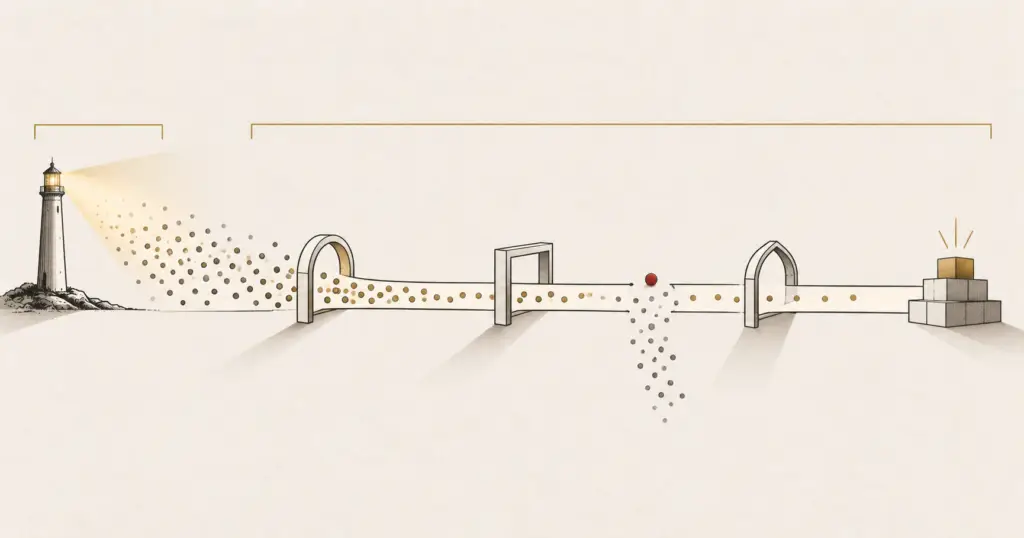
A CMO owns marketing. A Fractional Commercial Director owns the commercial engine. A Chief Marketing Officer is responsible for how the market hears about you: brand, demand generation, content, channels and campaigns. A Fractional Commercial Director is responsible for whether the market buys from you and at what margin: proposition, pricing, sales motion, qualification and growth. The two roles overlap at the edges, but they answer fundamentally different questions. The CMO asks how do we get attention. The Commercial Director asks how do we turn attention into profitable, repeatable revenue.
If you hire the wrong one, you can end up generating more leads for a proposition that does not convert, or sharpening a proposition that no one ever hears. Knowing which problem you have is the whole decision.
What a CMO owns
A CMO, fractional or full-time, leads the marketing function. Their territory typically includes:
- Brand strategy and positioning. How the business is perceived in the market and the story it tells consistently across every channel
- Demand and lead generation. Attracting the right volume of qualified prospects through the right mix of channels
- Content, campaigns and messaging. The material that builds awareness, earns attention and moves buyers closer to a conversation
- Website, SEO, paid media and social. The owned and paid infrastructure that makes the firm visible and findable
- Marketing team leadership and budget. Setting direction, prioritising spend and holding the function accountable for pipeline contribution
The CMO’s core question is visibility and demand. Are the right people aware of us, and are enough of them raising their hand?
What a Fractional Commercial Director owns
A Fractional Commercial Director sits one level wider, across the full path from problem to paid. Their territory typically includes:
- Proposition. What you actually solve, said in the buyer’s language, so the right buyer recognises themselves
- Pricing and margin. Setting price with intention, protecting margin, removing the discounting reflex
- Sales motion. A repeatable process with an entry offer, discovery, qualification and stage gates, rather than founder-dependent improvisation
- Commercial structure. The journey from a first engagement into a compounding, long-term relationship
- Proof and trust. The evidence a buyer needs at each step to decide with confidence
The Commercial Director’s core question is conversion and economics. When the right buyer arrives, do they understand us, believe us, and buy at a price that protects margin?
Side-by-side: the core difference
| CMO | Fractional Commercial Director | |
|---|---|---|
| Primary question | How do we get attention? | How do we convert attention into profitable revenue? |
| Owns | Brand, demand, content, channels | Proposition, pricing, sales motion, margin |
| Optimises for | Awareness and lead volume | Conversion, deal quality, margin |
| Success looks like | More of the right people aware and enquiring | The right buyers self-select and buy at the right price |
| Sits closest to | The market’s perception of you | The buyer’s decision to commit |

Why the distinction matters more than it looks
Here is the trap most founder-led firms fall into. They feel a growth problem, assume it is a visibility problem, and hire for marketing. But in a large number of cases the issue is not that too few people are looking. It is that when the right people do look, the proposition reflects the seller rather than the buyer. The buyer has to translate “what we do” into “can this help me,” and many simply do not bother.
When that is the real constraint, more marketing makes it worse, not better. You are paying to drive more traffic to a proposition that quietly loses people. Sharpening the proposition first means every pound of marketing spend afterwards works harder, because the message it carries finally lands.
This is why proposition tends to come before promotion. Get the commercial foundation right, then amplify it. Amplify a weak foundation and you simply reach more people with a message that does not differentiate you, which pushes buyers straight back into comparing on price.
Do you need a CMO or a
Fractional Commercial Director?
Use these signals to tell which problem you actually have.
You probably need a CMO if:
- Your proposition is sharp and converts well when people find you
- Your sales process works, but not enough qualified buyers are aware of you
- The constraint is reach, demand and pipeline volume
You probably need a Fractional Commercial Director if:
- You generate interest but struggle to convert it into profitable work
- Your proposition sounds like your competitors’ and invites price comparison
- Growth depends on the founder being personally involved in every deal
- You discount more than you would like, and margin is under quiet pressure
- You are not sure who your best-fit buyer is, so the wrong enquiries keep showing up
A simple test: if the problem is “not enough people know us,” lean CMO. If the problem is “people know us but don’t buy, or don’t buy at the right price,” lean Commercial Director.
Can one person do both?
In a smaller business, the lines blur, and a strong Fractional Commercial Director will naturally shape marketing because proposition and pricing dictate what the marketing should say. But the reverse is rarely true. A marketing leader is not usually equipped to own pricing strategy, sales qualification, deal economics and commercial structure. The Commercial Director role is the broader of the two. For many founder-led firms, getting the commercial engine right first is what makes a later marketing investment pay off.
Frequently Asked Questions
Is a Fractional Commercial Director the same as a fractional CMO?
No. A fractional CMO leads marketing on a part-time basis. A Fractional Commercial Director owns the wider commercial engine, including proposition, pricing and sales, on a part-time basis. Both are senior and part-time, but their scope is different.
Which should I hire first, a CMO or a Commercial Director?
If your proposition already converts well and you simply need more reach, start with marketing. If buyers struggle to understand or believe your proposition, or you compete too often on price, start with a Commercial Director, because fixing that makes all future marketing work harder.
Does a Fractional Commercial Director replace my marketing team?
No. They work alongside it. They define what the proposition is and what it should say, which gives the marketing team a sharper, more differentiated message to amplify.
Can a Commercial Director and a CMO work together?
Yes, and in larger firms they often do. The Commercial Director sets proposition, pricing and sales strategy. The CMO builds the demand and visibility around it. They are complementary, not competing.
What size business is this distinction relevant for?
It matters most for founder-led firms in the £1m to £15m range, where budget allows for one senior part-time hire but not several, making the choice of which role to prioritise a genuinely consequential decision.
I have also designed several free commercial diagnostic tools that you can take right away. Just click on the link below and complete them to get an instant report.
I look forward to meeting you.
Tom