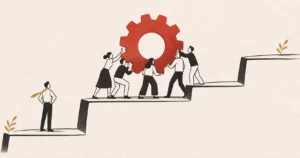

Addoli is now one year old, and I have spent that year living inside my own framework. The 7 Plateaus framework maps the business growth plateaus a founder-led business moves through, and I have used it on Addoli, live, as I build it.
Plateau 1 was The Starting Line. Plateau 2, First Proof, is where I am now. Plateau 3, The Busy Trap, is already visible ahead of me.
Here is what each stage looked like from the inside, and what it might tell you about your own business.
Key takeaways
- Every new business starts at The Starting Line, however much experience the founder brings.
- Saying no to the wrong work is a commercial decision, because a founder who is spread too thin becomes the bottleneck.
- The Busy Trap arrives as a run of good months, so the time to build systems and boundaries is on Plateau 2, before it lands.
What does The Starting Line feel like?
Plateau 1 is The Starting Line. However much experience you bring, every new business starts here. I brought 25 years with me, and the starting line was the same as it is for anyone else.
I began broad, looking for a sweet spot. I spoke to founders, business owners, funders, trusted advisers and other start-ups. I listened to how they described their problems, and I watched how they reacted when I described what I do.
The reactions were useful. One person asked if I was a “CEO whisperer”. Others confused my work with marketing or sales. Almost everyone understood the challenge a founder faces when there are only so many hours in the day.
Some of those early conversations were humbling. If you have ever explained your business to someone and watched them nod politely without really getting it, you will know the feeling. That is information. It tells you the offer is not yet clear enough.
So I kept listening and I kept narrowing. I shaped my services into something people understand and value, and settled on a clear role: Fractional Commercial Director, the Commercial No. 2 for founders who have outgrown doing it alone.
Why is saying no a commercial decision?
Every founder knows the early pull to say yes to everything. The diary is open, and every opportunity feels like it might be the one. Every payment feels like sustainability and growth, but it can also lead you to take on too much of the wrong work.
I said no more than felt comfortable. That was not about turning work away. It was about choosing the right work, choosing the people I want to work alongside, and protecting myself from being stretched too thin.
A Fractional Commercial Director who is spread across too many things becomes the bottleneck they were hired to remove.
Tom Wood
Protecting my time turned out to be one of the most commercial decisions I made all year. The freedom to do what I do best benefits my clients directly. It also gives me the headspace to keep innovating, keep building and keep my thinking alive.
What happens when you have time to build?
The work has been stimulating: the clients, the business models, the commercial problems we solve together. The surprise was rediscovering my creative side.
With time to think, I found myself doing for myself what I do for clients. I identified gaps, closed them, and built new tools and services. Some are for clients. Some are for how I run Addoli.
It has spilled over outside work too. I have designed and built a game to scratch an itch I have had for 20 years, and I am part of a Card Starter network collectively designing and launching a new card game internationally.
That is what year one gave me: a clear role, protected time and room to build. Never forget to have fun and enjoy what you do.
What does First Proof mean in practice?
Plateau 2 is First Proof. It is the point where what you offer stops being an idea and starts being something people buy, use and come back for. Addoli has moved there.
Proof shows up in the words of the people you work with. One client told me: “We have just won a new piece of business worth over £85,000 per annum, and our pipeline is very healthy.” Another said: “I have now taken on my first client. It’s a different vertical than I had planned, but you were right that the problem my software solves applies to others, too.”
A third put it more simply: “If you were an employee, you would be employee of the month… I wish we had found you two years ago.”
The next year is about building on that proof:
- More client work, and new relationships developing.
- Launching my first mobile app, a simple idea that can help a lot of people.
- Finishing the manuscripts for my books.
- Co-launching a new development programme with a partner in the new year.
- Continuing to evolve and embrace new technologies, ways of working and the opportunities that AI and other founders are bringing to this sector.
Why business growth plateaus arrive quietly
Plateau 3 is The Busy Trap, and I can see it from here. The business works, the clients are happy and the team is capable, but the founder is still in every significant decision, every sales conversation and every escalated problem. Growth caps at the founder’s available hours.
It does not arrive with a warning. It arrives as a good month. Then another. Then you notice you have not had a thinking day since the spring.
That is why I am putting foundations in place now: systems, tools and boundaries that reduce the impact before it lands. It is far easier to build them on Plateau 2 than to retrofit them on Plateau 3. If this pattern sounds familiar, why your growth has stalled explains more about what sits behind it.
How do you test which plateau you are on?
Most founder-led businesses do not have a commercial problem. They have a commercial gap: between where they are and where they need to be, and between what the founder can carry and what the business now needs.
It is hard to see that gap when you are in the weeds, and business growth plateaus are no easier to spot from the inside. A short test helps.
In practice
Take 10 minutes this week and answer three questions. Can a client describe what you do in one sentence, in their words rather than yours? What is one thing you are saying yes to that stretches you too thin? If you stepped away for two weeks, what would stop?
If a client cannot describe what you do, focus on your business model and positioning. The thing that stretches you too thin is usually the thing you enjoy least, so consider cutting it sooner rather than later. If the answer to the third question is most things, The Busy Trap is closer than it looks.
Frequently asked questions
What are the 7 Plateaus of business growth?
The 7 Plateaus are seven stages a founder-led business moves through: The Starting Line, First Proof, The Busy Trap, Almost There, The Engine Room, The Incomparable Business and Category Ownership. Each stage has its own main commercial challenge. Knowing which one you are on tells you where to focus, rather than trying to fix everything at once.
What is The Busy Trap?
The Busy Trap is Plateau 3. The business works, the clients are happy and the team is capable, but the founder is still in every significant decision, every sales conversation and every escalated problem. Growth then caps at the founder’s available hours. It usually arrives as a run of good months rather than a visible crisis.
How do I know which plateau my business is on?
Start with three questions. Can a client describe what you do in one sentence? What are you saying yes to that stretches you too thin? What would stop if you stepped away for two weeks? The free 7 Plateaus Assessment takes about 10 minutes and places your business on a plateau.
Why does every new business start at The Starting Line?
Every new business starts at Plateau 1, whatever experience the founder brings. The offer is still being shaped, and early conversations show where it is not yet clear enough. Listening, then narrowing your focus, turns a broad idea into a clear role that people understand and value.
Should a new business say no to work?
Yes, when the work is the wrong fit. Saying yes to everything can stretch a founder too thin, and an over-stretched founder becomes the bottleneck. Choosing the right work and the right people protects your time, and protected time gives you the headspace to keep building and thinking commercially.