Commercial frameworks
The Addoli Commercial Operating System
Proven diagnostic frameworks for £1m – £15m businesses
Learn the route to breaking through the 7 Plateaus.
The 5Rs of Diagnosis>Infrastructure>Positioning

Model 01: Diagnosis
What Are The 5Rs of Commercial Diagnosis?
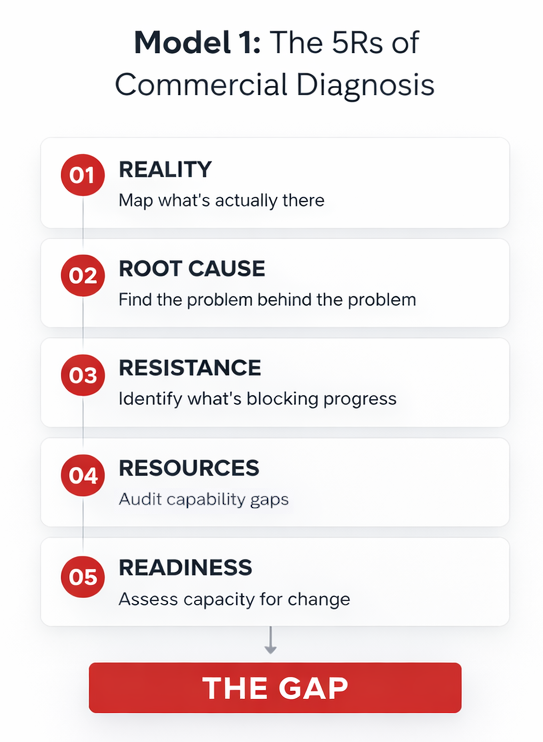
The 5Rs of Commercial Diagnosis are five lenses, Reality, Root Cause, Resistance, Resources and Readiness, that expose the gap between where a founder-led business actually is and where it thinks it is.
Seeing What’s Actually Broken
Expose what’s actually holding you back.
The 5Rs work together to surface the commercial gap between where you are and where you think you are.
01 - REALITY
Map what's actually there
Most founders operate from assumption, not evidence.
OutputA clear picture of where you actually are, not where you think you are.
02 - ROOT CAUSE
Find the problem behind the problem
Symptoms are visible. Causes are structural.
OutputThe true constraint behind stalled growth.
03 - RESISTANCE
Identify what's blocking progress
Cultural friction and hidden blockers surface here.
OutputThe forces slowing momentum.
04 - RESOURCES
Audit capability gaps
Do you have the skills in the business?
OutputThe capability delta to reach the next plateau.
05 - READINESS
Assess capacity for change
Can the organisation absorb the next level?
OutputWhether you’re structurally ready to scale.
Are you solving the right problem?
Take the 5-minute Commercial Diagnosis Assessment. No pitch.
Model 02: Infrastructure
What Are The 5Rs of Commercial Infrastructure?
The 5Rs of Commercial Infrastructure are five dimensions, Repeatable, Reliable, Resourced, Responsive and Resilient, that define the commercial infrastructure a business needs to grow beyond founder-led execution.
Build the systems that support scale
Build the systems that remove founder dependency.
Most businesses plateau because their infrastructure cannot support the next level of scale. These five dimensions define the capability required to grow beyond founder-led execution.
01 - REPEATABLE
Document processes so they work without you
The founder knows how everything works. But if it isn’t documented, it isn’t repeatable. And if it isn’t repeatable, it can’t scale.
This isn’t bureaucracy. It’s codifying what works so others can execute it reliably.
OutputPlaybooks that enable independent execution without loss of quality.
02 - RELIABLE
Create systems that deliver consistently
Documentation creates repeatability. Systems create reliability.
If something only works when the founder is involved, it isn’t a system yet. It’s founder dependency.
OutputInfrastructure that delivers consistent results regardless of who executes.
03 - RESOURCED
Build complementary leadership capability
No founder excels at every dimension required for scale.
Growth from £1–15m requires leadership capacity that complements your strengths and compensates for your weaknesses.
Not cloning yourself, building capability around you.
OutputLeadership capacity that removes founder bottlenecks.
04 - RESPONSIVE
Design for agility and continuous improvement
Infrastructure must enable adaptation, not prevent it.
Experiment → Measure → Learn → Iterate
This cycle must be embedded into how the business operates, not dependent on founder intervention.
OutputSystems that improve continuously without becoming rigid.
05 - RESILIENT
Build infrastructure that survives transitions
The ultimate test of infrastructure is whether it survives without the founder.
A resilient business continues operating, delivering, and adapting regardless of leadership change.
Otherwise, it isn’t a business. It’s a job.
OutputA business capable of sustaining performance independently.

Can the business run without you?
Take the 5-minute Commercial Infrastructure Assessment. No pitch. Just clarity.
Model 03: Positioning
What Are The 5Rs of Market Positioning?
The 5Rs of Market Positioning are five layers, Reframe, Redefine, Relevance, Relationship and Return, that build positioning buyers cannot easily compare, so the business stops competing on price.
Making competition irrelevant
Most founders don’t have a delivery problem. They have a positioning problem.
If buyers can’t immediately understand why you are the obvious choice, you are forced to compete on price, relationships, or persistence.
Positioning removes comparison. It makes the decision easy.
These five layers build positioning that attracts, converts, and compounds.
01 - REFRAME
Change How Prospects Think About the Problem
Before you can position differently, you need prospects to see the problem differently.
Most businesses make the mistake of accepting how prospects frame the problem, then trying to be the best solution to that framing.
OutputProspects understand the real problem they’re facing, not just the symptom.
02 - REDEFINE
Create a New Category
Reframing changes how prospects see the problem. Redefining creates a new category of solution.
You’re not building a better version of what exists. You’re building something fundamentally different that makes comparison irrelevant.
OutputA category of one where you set the rules rather than following them.
03 - RELEVANCE
Position for Specific Situations
Redefining the category is powerful. But relevance makes it real.
You need to be the obvious choice for a specific situation, not a general option for general needs.
OutputPositioning that makes ideal prospects say “finally, someone who gets it.”
04 - RELATIONSHIP
Build Partnership Thinking
Once you’ve positioned as relevant and different, the nature of client relationships changes.
You’re no longer a vendor competing on price. You’re a partner solving problems that matter.
OutputRelationships that compound over time, not reset with each transaction.
05 - RETURN
Optimise for Long-Tail Value
The final R brings it full circle to where this framework starts: the long tail.
Everything in this positioning model leads to one choice:
Do you optimise for this quarter or this decade?
OutputDecisions that create compounding value over years, not just quick wins now.

Want to know where you're stuck?
Take the 5-minute 7 Plateaus Assessment. No pitch. Just clarity.
The connected system
How The Three Models Work Together
The real power comes in how they connect. That’s the breakthrough.
