
Ask a room of business owners what makes their company different and you will hear the same five answers before the coffee goes cold: our people, our service, our relationships, our experience, we really care.
None of those are bad things to have, but none of them are advantages either, at least not in the way that matters. They rarely cause a customer to choose you over a credible competitor, and that is the only job a competitive advantage has.
Five things founders call an advantage that may not be one
- Being cheaper is not an advantage. It is a discount, and anyone willing to earn less than you can copy it by Tuesday afternoon.
- Being better is not provable, and everyone claims it anyway. “High quality” and “a trusted partner” are not differentiators. No one is going to write, “We are rubbish and untrustworthy,” whether they are or not.
- Working harder is a capacity warning, not an advantage. If you are constantly busy and working hard, how are you going to fit this new prospect into your schedule?
- Your people is on your competitor’s website too, in almost identical words. If the sentence works for them as well as it works for you, it is not working for you. So many firms say their people and customers are the most important thing to them, yet their number one business target is EBITDA, which does not correlate well.
- Longevity tells a buyer that you have survived. It does not tell them you are right for the problem sitting in front of them right now. It may even make them worry you have become stale and stuck in your ways.
The truth is that none of these are bad things to have. It is just that they do not do the one job an advantage is supposed to do, which is make a customer pick you over a credible alternative when both are sitting in front of them.
Most founders do not discover this by accident. They discover it because a customer keeps choosing a cheaper or apparently weaker competitor, and the explanations offered internally, tighter margins, a slicker pitch deck, an aggressive sales team, all turn out to miss the real reason.
The logo test
Here is a quick way to check whether your strongest claim is really working for you.
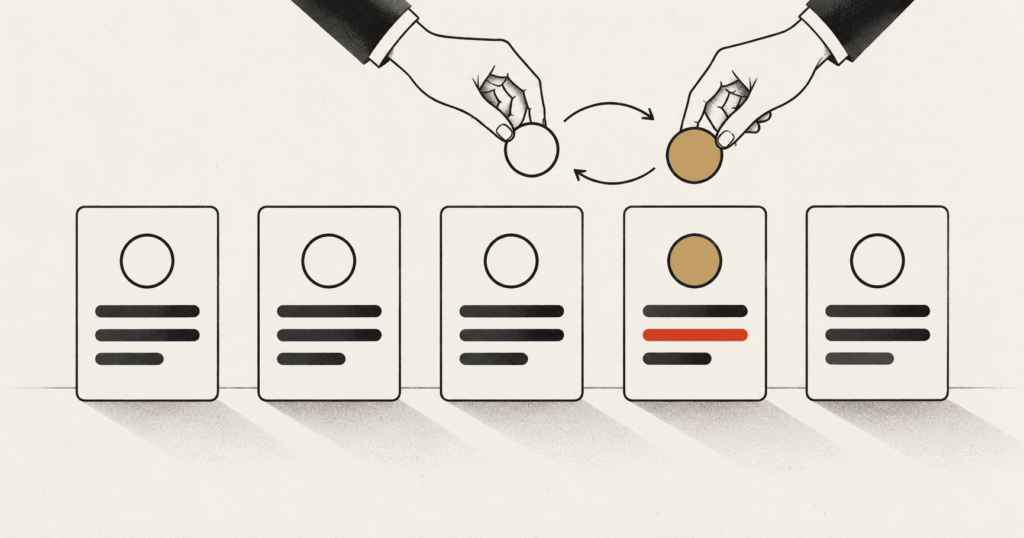
Take the boldest line on your website and put your closest competitor’s logo above it. Would it still set you apart?
If the answer is no, that line is not giving a customer much reason to choose you. It is describing a decent business. It is not describing why they should buy from yours instead of theirs.
The phrases that come up most often in proposition reviews are “one of the leading firms in our sector,” “a team of experts” and “trusted partner.” Add “high quality,” “we care,” “tailored solutions” and “unrivalled” to the list. These are the phrases businesses reach for when they have not quite worked out what makes them different, and they fail the logo test almost every time.
Try it on your own website now. Read your strongest paragraph back with a rival’s name sitting above it instead of yours. If it still reads true, keep it. If it reads like it was written for anyone in your sector, it was.
Ask the customer, not the leadership team
This is where most businesses make things harder than they need to be.
They get the leadership team in a room to workshop the proposition. They cover a wall in Post-it notes, scribble on flip charts and call it a culture day. They debate words for an afternoon, and eventually produce a nicer way of describing what they already believed. It would still sound like the list above.
There is a much easier place to start, and it sounds almost too obvious to say out loud: ask your customers, not your leadership team. Particularly the ones who had a genuine choice.
Why did you choose us? What were you comparing us with? What nearly stopped you buying? What would you miss if you moved somewhere else? What are we not doing that you would value from us?
Then ask a few people who did not buy from you.
You will often find that the thing you are proudest of is not particularly important to them. Meanwhile, something you barely mention, something you have not even registered as a selling point, turns out to be one of the main reasons they chose you. Competitive advantage starts in the customer’s head, not yours, and you only find out what is there by asking.
This also works best when it is not you asking. A customer who chose you will soften the answer if you are the one on the call, either out of politeness or because they assume you already know. An independent third party tends to hear the blunter, more useful answers.
Where weak differentiation shows up
You can usually spot the problem before you run a single interview. Just look at what happens when you reach the price conversation.
If customers regularly ask you to shave a bit off the price. If your salespeople keep telling you the market is becoming price sensitive. If you keep losing to cheaper competitors. Sometimes price really is the problem. Often it is not.
Often the customer simply cannot see enough difference between the options in front of them, and if three firms all look roughly the same, choosing the cheapest one is the rational choice, not the wrong one.
You do not fix that with a better objection-handling script. You fix it by giving the customer a stronger reason to choose you before price ever comes up. Sales teams get blamed for margin erosion that was decided months earlier, at the point where the proposition was written to sound like everyone else’s.
A print shop understood this before I did
I needed some orders of service printed for a memorial this week. I walked into the local print shop and placed the order there rather than using an online printer that would have been considerably cheaper.
Why pay more? Because I could talk to someone about the print quality and the short lead time. Because I could see examples and a live copy printed in front of me. Because they could have it ready within twenty four hours with no risk of a courier letting me down. Supporting a local business mattered too, though it was not the deciding factor.
Nobody wants to turn up to a memorial with poorly printed orders of service, or no orders of service at all. Once I weighed those factors, price was not in my top three considerations, and I did not bother shopping around online for quotes. I already knew it would be more expensive.
That print shop knew exactly what its advantage was. It was not “quality printing,” “friendly service,” or “20 years’ experience.” It was certainty, delivered on a deadline that mattered, for a job where getting it wrong was not an option. The queue at the till suggested plenty of other people had reached the same conclusion, and the owner almost certainly did not discover that advantage in a marketing workshop. It came from watching what customers asked for under pressure, and listening to the feedback they gave.
Most B2B firms have a version of this sitting in their own history. A deal that closed despite being the expensive option. A client who stayed through a mistake that should have lost them. A reason customers give when asked why they called you first. It rarely matches the line on the website, and it is almost always more specific and more useful than anything a workshop would have produced.
The point
An advantage only earns the name if it survives having a competitor’s logo put above it, and if it is the reason a customer chose you rather than something you assumed mattered to them. Most founders have never tested either.
It is genuinely hard to see your own proposition clearly from inside it. You know too much about the business to read your own website the way a stranger does, and you are too close to the decision to notice when a claim has quietly become industry wallpaper rather than something that sets you apart.
The fix is not a better tagline. It is going back to the people who did choose you, listening properly to what they say, and being willing to hear that the thing you lead with on the website is not the thing that won you or keeps you the business.
If you want to find out where your own proposition would land on that test, that is exactly what the Proposition Architect diagnostic is built to show you.
FAQs
How do I know if my competitive advantage is real?
Put your strongest website claim through the logo test. Place a competitor’s name above the same line. If it still sets you apart, it is real. If it reads like it could belong to anyone in your sector, it is not.
What is the logo test for competitive advantage?
The logo test is a quick check for proposition claims. Take your boldest line and imagine a rival’s logo sitting above it instead of yours. If the claim still feels distinctive, it is doing its job. If it reads as generic, it is industry wallpaper rather than a genuine differentiator.
Why do customers say price is the problem when it usually is not?
Price becomes the deciding factor when a customer cannot see enough difference between the options in front of them. If three firms look roughly the same, choosing the cheapest is a rational response, not a failure of loyalty. The fix is a stronger reason to choose you before price is raised, not a better objection-handling script.
Why ask customers rather than the leadership team about what makes a business different?
A leadership workshop tends to produce a nicer version of what the team already believed. Customers who had a genuine choice can point to the real reason they bought, which is often something the business barely mentions on its own website. An independent third party asking the questions tends to get the blunter, more useful answers.