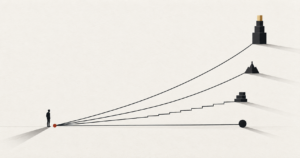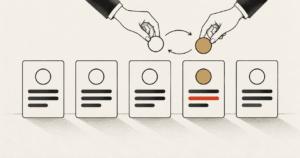

Three numbers from FRP’s Decision Economy Research are hard to shake. 85% of leaders say decision making has become harder. Only 32% think decisions are happening at the right speed. And 73% believe faster commercial decisions would improve profit margin.
Everyone agrees decisions matter, yet almost nobody thinks they are fast enough. In a founder-led business, the problem is rarely speed for its own sake. Most commercial decisions are never consciously made at all.
They happen by default, by absence, or they never leave the founder’s desk. Each one delays the commercial outcome sitting behind it.
Key takeaways
- Delay does not just slow a decision down, it delays the commercial outcome sitting behind it.
- Most founder-led delay comes from three patterns: the default decision, the absent decision and the bottlenecked decision.
- The businesses closing the gap make small, compounding improvements to how decisions get made, rather than one big decisive call.
What does a delayed decision cost?
In any organisation, delay does not just slow a decision down. It delays the commercial outcome sitting behind it. A pricing change, a hire, a channel shift or a decision to stop doing something all carry a result that cannot arrive until the call is made.
The businesses closing the gap are rarely making one big, decisive call. They make small improvements to how decisions get made, and they let those improvements compound.
In founder-led businesses, I see three patterns. The first is the default decision, where the business drifts into a choice nobody examined. The second is the absent decision, where nobody is looking up. The third is the bottlenecked decision, where everything waits for the founder.
Are you defaulting on customer acquisition?
Your best clients probably came from a referral. Your marketing budget probably went somewhere else.
A Harvard Business Review analysis of more than 10 million consumers found that about 20% of new customers arrived by referral. Those referrals produced 72% of the profit from all new customers. Numbers like that cannot be ignored.
Referred customers cost less to acquire, stay longer and refer more people themselves. That compounds profitability over time. Most firms overlook the channel and default to new business acquisition. That delayed thinking leads to serious wastage.
Referrals should not be left to luck. Build them into the business model and the infrastructure, the same way you build new business sales. A repeatable, owned referral channel is part of your commercial infrastructure. A channel with no owner and no measure is a channel nobody has decided about.
Three questions test it:
- What share of last year’s new revenue came from referral?
- Who owns that metric?
- What happens if your own network runs dry?
Is flat revenue stability or drift?
The riskiest business is not always the one expecting to decline this year. It may be the one expecting to stay flat and accepting that position without much thought.
Flat is easily mistaken for stability. In practice, flat businesses stop looking up. Nobody scans the horizon, the status quo feels comfortable, and a few heads are quietly in the sand. It feels warmer and safer there.
That is where the risk sits. Not in the flat revenue line, but in the fact that nobody is watching for what changes it. A key client or employee moves on. A competitor reprices. A market shifts underneath you.
Watching for it needs two things: someone whose job it is to look, and information clean enough to trust when they do. Certainty rarely comes from waiting for more data. It comes from making sure the data you already have is in good enough shape to act on.
The job is not to push every founder to grow. It is to separate flat by choice from flat by drift. If you have stalled growth and are calling it steady, ask yourself three questions:
- What opportunity have you chosen not to pursue, and why?
- What would have to happen for revenue to drop 20%?
- Who else in the business could answer either question?
Steady only stays steady if someone is planning for the day it stops.
Tom Wood
Is every decision waiting for you?
Ask your team where the business is going. Most will have an idea. Now ask them which customer they would turn away.
That is the more revealing test. A clear direction tells people not only where you are heading, but what to ignore. If every question about whether the business can say no to something comes back to you, you are the blocker.
I call this pattern the Busy Trap, and it is Plateau 3 in the 7 Plateaus framework. The business is operationally capable and the team is competent. The founder is still in every significant decision, every sales conversation and every escalated problem. Growth gets capped at the founder’s available hours.
Act decisively within your constraints, or the constraints end up deciding for you.
In practice
This week, check three things. Who approved the last deal that was discontinued? Who decided the last event you paid for was worth it? Who made the call on the last prospect the business walked away from? If the answer is you to all three, the direction sits with you, not in the business.
Why does an outside view help?
Proximity hides things. Stepping outside the business long enough to look shows which channel is quietly outperforming, where revenue is being left on the table, where risk is building without anyone watching, and which decisions have nowhere to land except the founder’s desk. It also shows which decisions to prioritise and which to put at the back of the queue.
Clear, outside-in thinking tends to surface the same three things quickly: a channel being underused, a risk nobody owns, and a decision only the founder can currently make. Each one causes delay.
Spotting them is the diagnostic. Getting on with the build, removing the bottleneck and closing the gap, is the actual job. That is the work of a Fractional Commercial Director.
The value is not in more advice. Advice only adds to a list of things to do that never get started. It is in outcomes rather than tick-box reviews, and in helping the team deliver those outcomes faster than a founder working alone inside their own blind spots.
More meetings will not fix any of this. Neither will another dashboard. Bring outside support in early and it frees your attention for the handful of decisions that genuinely need you in the room, rather than all of them.
Frequently Asked Questions
Why do founders delay commercial decisions?
Most commercial decisions are never consciously made. They happen by default, by absence, or they never leave the founder’s desk. The delay is rarely about speed for its own sake. It comes from channels nobody owns, nobody watching for risk, and a founder involved in every significant call. Each delay postpones the commercial outcome behind it.
What is the Busy Trap?
The Busy Trap is Plateau 3 in the 7 Plateaus framework. The business is operationally capable and the team is competent, but the founder is still in every significant decision, sales conversation and escalated problem. Growth gets capped at the founder’s available hours. A simple test is to ask who approved the last deal, event or prospect decision.
How do I tell flat by choice from flat by drift?
Flat by choice means you can name the opportunities you chose not to pursue and explain why. Flat by drift means nobody is watching for change. Ask what would have to happen for revenue to drop 20%, and who else in the business could answer. If only you can answer, or nobody can, the flat line is probably drift.
How can a founder stop being the bottleneck?
Start by finding which decisions only you currently make. Check who approved the last discontinued deal, the last paid event and the last prospect the business walked away from. Then make the direction clear enough that the team knows what to say no to. An outside view helps, because proximity hides these patterns.