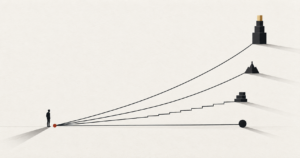

Every business runs two ledgers.
The first is easy to read. It is the spreadsheet. Rent versus buy. The local hire versus the cheaper hire elsewhere. The functional office versus the one that costs more. Every option has a number, and the smaller number always looks like the disciplined choice.
The second ledger never gets opened. It is where the return on the more expensive decision actually lands: loyalty, reputation, sustainability, the kind of trust that gets you a phone call you did not have to chase. Value that is real, that compounds, and that is almost impossible to prove in advance. So it does not get funded.
Most leaders read the first ledger well and never see the second. Not because they are wrong about the numbers, but because they are only ever shown half of them. They are optimising for short term targets with short term thinking.
Here is what the second ledger looks like in practice, using a business that grew up in a store room above a shop and ended up taking on a landmark building.
From a store room to a landmark
At RWA, the business started in a store room above a shop in Blaenavon. No carpets, boxes everywhere, a borrowed corner in a small Welsh town, a long way from anywhere anyone would tell you to build a market-leading company.
Next came an old pub, then by 2019 the business was working from the Old Library, a landmark Grade II listed building in the centre of the same town, four times the footprint of the office before it, restored and full of people.
Almost every decision that connected one to the other would have looked, on the spreadsheet, like money that did not need spending.
The old pub on the high street
In 2013 the business bought its first proper office: an old pub on the high street in Blaenavon that had sat empty for years.
The sensible, short-term move would have been to rent something cheap and functional, or move into serviced offices outside the town. Instead, the business bought a derelict pub and converted it at significant cost. Training facility, offices, a boardroom. And because you keep the character when you buy an old pub, the bar stayed, along with a pool table, jukebox and dartboard. The downstairs lounge became the breakout space where the team decompressed and, more often than expected, where the good ideas actually happened.
On a cost line, none of that is justifiable. A bar in an office. A pool table. Buying a building outright when renting was an option. Renovating it completely.
But this was not office space being purchased. It was an environment people wanted to be in, somewhere ideas could move around informally and a team could bond beyond their desks. You cannot put a number on that in advance, which is exactly why the short-term thinker never buys it.
There was a second return the pub generated, and it was bigger than the building.
What a business does to the town around it
When a business recruits locally and puts a real, active operation into an empty building on a struggling high street, the effects ripple outward in ways that have nothing to do with the P&L.
Local restaurants got busier when clients and remote staff visited. The B&B took more bookings. The grocery stores supplied the lunches. Young people in the area found career opportunities without leaving home to find them. The business supported local charities, sponsored local teams and invested time in launching community events. The high street had a vibrant, working business in it instead of another dark window.
That is the long tail operating at the level of a whole community. This was not only a profitable company being built. It was something that created value for people who never appeared on an invoice.
Here is the commercial point the spreadsheet misses entirely. That ecosystem fed back into the business. The town became a place people wanted to work and stay. Loyalty ran deeper because the jobs meant more than a salary. Reputation locally became a recruitment engine and a trust signal that never had to be bought. The investment that looked one-directional on the cost line was quietly compounding on the value side.
Big enough to deliver, small enough to care
By the end of that year, the business had earned the tagline it used for years: big enough to deliver, small enough to care.
Big enough to deliver meant national reach, hundreds of clients onboarded, proper systems, a platform integrated with a major insurer’s infrastructure.
Small enough to care meant personal relationships, local employment, a culture built around doing right by clients rather than extracting the maximum from them.
Most founders think those two things pull in opposite directions, that to get big enough to deliver you have to give up small enough to care, that scale and soul are a trade-off.
They are not. The place-based, community-rooted decisions were precisely what allowed the business to hold onto the second half of that tagline while growing into the first. The provenance was not sentimentality slowing growth down. It was the thing that made the growth mean something, and stick.
The Old Library
By 2017, the business had already outgrown the pub.
The local council owned the Old Library, a landmark property in Blaenavon that needed investment. They came asking whether the business would be interested in taking it on.
This was not a business passing through. It had already proven, through the pub, through local hiring, through years of showing up, that it was committed to the place.
The business agreed, and the Old Library became its headquarters. Four times the space, modern facilities, room for a growing team, and a genuine landmark restored for use in the town centre. It remains in use by the people working there today.
The pub was not left empty behind. It was sold to another growing local business that needed the room to expand, one that could stay in the town and invest in it exactly as had been done before. The foothold that had been built did not collapse when the business left it. It passed to someone else who kept it working.
That is the second ledger at its clearest. The value created in that building was never tied to ownership of it. It rippled outward, kept going without the original business, and left the high street stronger than it was found. None of that came from a spreadsheet. It came from years of decisions a short-term eye would have called overreach, each one quietly earning the next.
The decision the spreadsheet cannot make
Almost every choice in that arc, from the store room to the Old Library, could have been argued down on cost. Rent, do not buy. Skip the bar. Hire cheaper, further away. Do not take on the landmark. Save the money now.
Every time, the harder, more expensive, slower option was chosen. That was the long tail being invested in, rather than this quarter’s number being protected.
The saving is always on the first ledger. It is a line you can point to. It feels like discipline. The return sits on the second ledger, diffuse, delayed and impossible to prove in advance. The compounding has to be believed before it can be seen.
Most people default to the saving. Not because they are wrong about the numbers, but because the numbers they are reading only ever show one side. The cost is legible. The compounding is not. So the compounding never gets funded.
The businesses that break through their plateau are almost always the ones that learned to read the second ledger anyway.
So the next time a decision would cost something to do properly and save something to do cheaply, the question is not which number is smaller. That is the first ledger talking, and it only knows the cost.
The better question is what it is worth on the ledger that cannot be seen. What it builds for the future. That is where the value has been hiding the whole time.