
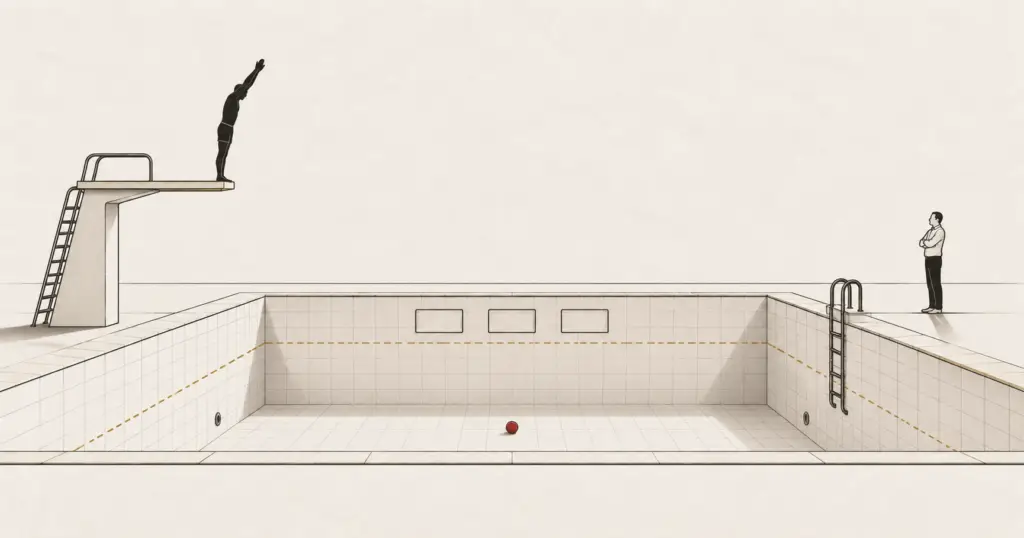
Most sales hires in founder-led businesses fail because the business has no commercial infrastructure for them to execute against, not because the wrong person was hired. No documented positioning, no sales playbook, no pipeline system. The hire inherits a role that only the founder could ever do, because only the founder carries the knowledge the role depends on.
If you have hired a salesperson and it did not work, this is almost certainly what happened.
What actually happens when a founder hires a salesperson
The founder has been closing deals for years. Prospects buy because the founder can diagnose their problem in the first conversation, adjust the pitch in real time, and carry twenty years of credibility into the room. None of that is written down. It does not need to be, while the founder is doing the selling.
Then the salesperson arrives. They are given a laptop, a CRM login, a target, and a brief that amounts to “sell what we do.” Within a quarter, the pattern appears: activity is high, conversion is low, and deals only progress when the founder joins the call. Within two quarters, everyone quietly agrees it is not working. The salesperson leaves or is managed out. The conclusion drawn is “we hired the wrong person.” So the business hires again, into the same missing system, and gets the same result.
Why “hire better” is the wrong fix
The instinct after a failed hire is to raise the bar: more experience, better sector knowledge, a bigger basic. But a stronger swimmer does not fix an empty pool. Experienced salespeople fail in these businesses for the same reason junior ones do. They are asked to sell an undifferentiated proposition, with no defined buyer, no repeatable process, and no source of pipeline beyond their own cold effort, while competing internally with a founder who closes on personal authority they cannot replicate.
What a sales hire actually needs to succeed
Three things, in this order. Positioning that does the heavy lifting: an issue-led proposition, so the buyer recognises their own problem before price enters the conversation. A salesperson can sell a sharp proposition. Nobody can sell a vague one except the person who invented it. A documented playbook: who the buyer is, what triggers the need, the discovery agenda, qualification rules, stage gates, and answers to the ten objections that always come up. A pipeline system: a defined mechanism that generates conversations, so the hire spends their time converting demand rather than manufacturing it from nothing.
Build these first and an average salesperson performs well. Skip them and an excellent salesperson fails slowly and expensively.
How to diagnose whether it was the person or the system
Ask four questions. Could anyone other than the founder have succeeded in the role as it existed? Was there a written sales process before the hire started? Did marketing or referral systems generate pipeline, or was the hire expected to create their own? Did deals convert when the founder joined, but stall when they did not? If the answers are no, no, no, and yes, the person was never the problem.
FAQ
Why did my first sales hire fail? Most first sales hires fail because the business had no commercial infrastructure for them to work within, not because the person was wrong. Without documented positioning, a sales playbook and a pipeline system, the hire inherits a role only the founder could ever do, because only the founder carries the knowledge it depends on.
What percentage of first sales hires fail in small businesses? Reliable UK figures are scarce, but among founder-led firms the pattern of a first sales hire departing inside twelve months is common enough to be a recognised failure mode. The consistent factor is missing infrastructure rather than candidate quality.
Should I hire a sales manager instead of a salesperson? Neither fixes the underlying problem. Management cannot compensate for a missing system. Build the positioning, playbook, and pipeline first, then decide what role the system needs.
How long should I give a new sales hire? With working infrastructure, expect meaningful signal within one quarter and consistent conversion within two. Without infrastructure, no timescale is fair, because the outcome was set before they started.
The most expensive sentence in founder-led business is “we hired the wrong person.” It costs a salary, a year, and usually a second identical mistake. The hire did not fail. The system they were handed did, and the system was never built. Build it first. People follow.