
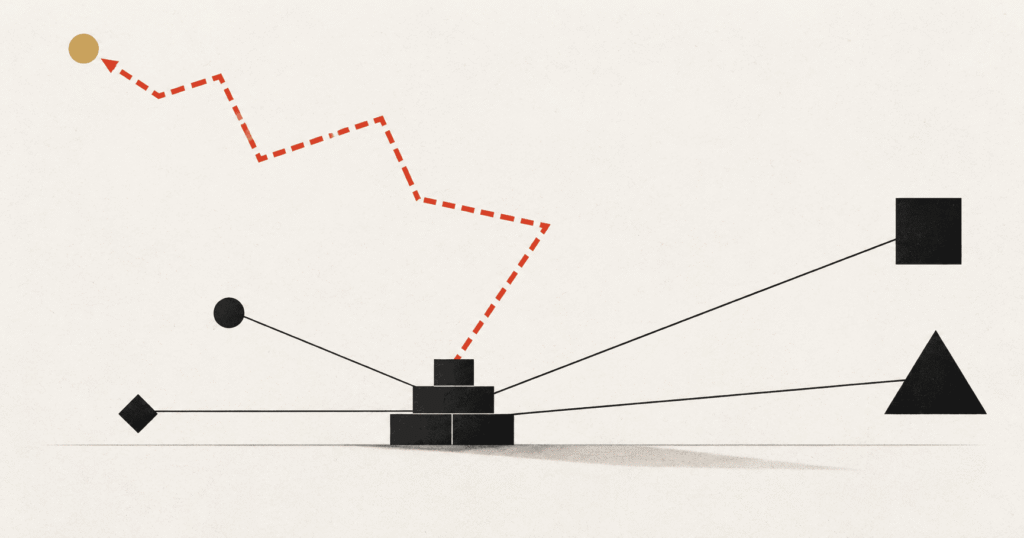
Recently at a dinner in London, a question came up that everyone understood, but each person had a different point of reference: what do you do when you need, or want, to change your business model?
None of the businesses around the table were failing. All were profitable, established, and respected in their space. But each owner knew that the business today was not the business of three years ago, and was unlikely to be the same business in another three years.
Here is what we discussed: for each person at the table, their business model (how they create, deliver and capture value through customers, employees, suppliers and owners) was still pointed inwards at the stage that built the business. Nobody had gone back and asked what each of those relationships needed to look like now. The business had clearly changed, but the model was still written for something that now looks completely different on the outside.
Three pivots, one business
I have lived this more than once, inside the same business.
The first pivot was a blue ocean move. Alongside an existing compliance consultancy for insurance intermediaries, we built an e-learning platform that turned regulatory training into a readily accessible product instead of a service. The model allowed the business to expand at a rate far greater than if we had continued as a consultancy alone. The platform became market leader.
The second was a ceiling pivot. The pool of insurance intermediaries is finite, and shrinking through market consolidation, and we could see we were running out of customers inside it. So we changed who the model was built around: stripped out the regulatory content, rebuilt for a wider market, and took it to SMEs, charities, chambers of commerce, schools, even prisons. The same product logic, but an entirely different customer stakeholder.
The third was an exit pivot: a sale during the pandemic, then a merger with the business that had been our biggest competitor for fifteen years. That was the owners’ relationship to the business changing. What we wanted from it, and what it could realistically give us, had moved on.
Three pivots, arguably four, and a different trigger each time: a shift in what a stakeholder wanted, a range of services competitors could not match, a ceiling on how many ideal customers existed, and a change in what the shareholders wanted from the business. None of it was the same problem wearing a different disguise. Each pivot needed its own model, built from scratch around the relationships as they stood at that moment, not the ones the business was originally built on.
The business model vs the business plan
People use these terms interchangeably. They are not the same thing, and mixing them up is exactly how founders and business leaders end up fixing the wrong one.
The business model is how you make money: who you create value for, what they give you in return, and the mechanics of that exchange. It is structural. It should not change often, but when it does, it is because something about who you serve, or what they want, has genuinely moved. Business history has no shortage of firms that did not survive change because they failed, or were too slow, to adapt their business model.
The business plan is how you are going to do it this year: the campaigns, the hires, the targets, the sequence of moves. It is tactical. It should change constantly. That is what a plan is for.
Most people diagnose it the wrong way round. Effort goes up, growth flattens, and the instinct is to rewrite the plan: new marketing, a new hire, a reprice, another push. If the real problem is the model, and the stakeholders the business was built around have changed, a sharper plan just gets you further, and faster, in the wrong direction.
The reverse happens too. Leaders declare the model broken and start again from scratch, when the truth is simpler: the model is still right, the execution has gone stale.
One question does the diagnosis: has what your stakeholders want, or who they are, changed? Or have you simply stopped doing the thing that used to work?
The first is a model problem. Rebuild it. The second is a plan problem. Rewrite it.
Confusing the two is expensive either way.
What outgrowing your model looks like
- A growing share of your customers behave nothing like the ones who built your reputation, but you are still serving them through the same relationship.
- The business has matured, but the relationships have not kept up.
- New hires are asking for things your first hires never needed from you: structure, a career path, clarity on how decisions get made.
- The delivery approach that made your early clients loyal does not fit the volume or profile of the clients you are winning now.
- What you need from suppliers or partners has changed, but the terms of those relationships were never renegotiated.
- The stakeholders who mattered most when you built the business are not the ones carrying it now, but the model still assumes they are.
Why it happens
A business model is not built for growth in general. It is built for a stage: a snapshot of what your key stakeholders wanted from you, and what you wanted from them, at the point you built it. The founder-led, entrepreneurial sales model that won your first clients was the right answer to what those early customers wanted: you. The bespoke delivery that built your reputation was right for a customer base small enough that bespoke was still deliverable.
The mistake is not building a model that eventually stops working. Every model is stage-specific by design; that was never avoidable. The mistake is treating it as permanent, and not going back to ask what your customers, employees, suppliers and owners want from you now, and what you need from them in return, until the gap is big enough to hurt.
What changes
Moving past this is not about working harder inside the current model. It is about deliberately re-examining what each stakeholder needs from you now, against what the model still assumes:
- Go back to each key relationship, customers, employees, suppliers, owners, and ask what has changed since you built this.
- Separate what built your reputation from what now needs to scale.
- Systemise the decisions only you currently make, so delivery stops depending on you personally.
Do this on a schedule, not in a crisis. If you use the 7 Plateaus framework, treat each transition as a natural trigger to go back and check the model. Not because moving through a plateau proves it is broken, but because it is a good, regular point to look. The businesses that get caught off guard are not the ones whose model broke; every model eventually does. They are the ones who only looked at it once it was already on fire.
Letting go of the model that got you here can feel like abandoning what worked. It is not. It is retiring it, on schedule, before it starts working against you.