

Imagine you are driving on the motorway. You hit 60mph and the steering wheel starts to vibrate violently. It is uncomfortable, it is distracting, and it is stopping you from accelerating.
What do you do?
You would not pull over, open the boot and fit a brand new steering wheel. You know, intuitively, that the steering wheel is not the problem. It is simply the place where a deeper issue, misaligned tracking or an unbalanced tyre, has become impossible to ignore. Replace the wheel and nothing changes. The moment you hit 60mph again, the shaking returns.
Yet this is precisely what business leaders do every week when revenue stalls.
They look at a flatlining growth curve, point at the dashboard and say one of two things:
“We have a sales problem. The team is not closing.”
“We need more marketing. We just need to get our name out there.”
They pull over and replace the steering wheel. Sales and marketing are rarely the problem in isolation. They are the vibrating steering wheel: the first places where a structural alignment issue makes itself known.
When you rush to fix the symptom, you simply drive a misaligned business faster.
Why you need an outside-in view early
When your car shakes, you do not guess at the cause and start dismantling the dashboard yourself. You bring in a mechanic to open the bonnet, connect the diagnostic equipment and look at the engine objectively, from the outside in.
Bringing that outside-in perspective in early is how a business avoids both failure and leadership burnout. The purpose is not to hand you another framework. It is to help you understand the real mechanics of your own business, so you stop spending money fixing the wrong things.
When a commercial system is misaligned, forcing it to move faster by buying more leads or hiring more sales people does not fix anything. It builds pressure. If the underlying cause is left alone, that bottleneck eventually takes on more load than it can carry, and something vital gives way. It might be your delivery team burning out. It might be cash flow. Often it is your own capacity as a founder.
The anatomy of a disconnected engine
Look wider and the real patterns of misalignment usually sit across three areas under the bonnet.
1. The proposition gap
Outdated pricing. Your rates and service lists have not moved in three years, while the underlying cost of delivery has risen sharply.
Mismatched solutions. The team is still selling a proposition that quietly stopped matching what the market actually needs, or actually buys.
2. The communication chasm
The marketing disconnect. Marketing builds a strong campaign around updated messaging in order to drive leads.
The sales undermining. The sales team quietly contradicts that positioning in pitches, because nobody brought them into the conversation when the message changed.
Over-promising in delivery. Sales commits to bespoke work in order to close a deal, leaving operations to support claims the business cannot scale.
3. The founder bottleneck
The personal system. Every important relationship, significant deal and strategic decision still passes through the founder’s personal capacity. And the founder is not available.
The ghost budget. The team is being asked to sell a legacy service line the founder mentally abandoned eighteen months ago. The budget line still exists. Nobody thought to ask why.
When the people shaping how the business is seen and the people shaping how the business runs are never in the same conversation, confusion is the inevitable result.
The commercial symptom trap
The pattern repeats in a predictable sequence. The marketing message drifts out of alignment with the sales pitch. Sales over-promises in order to compensate. Operations then fails to deliver against those promises. Meanwhile the same misalignment feeds the root bottleneck, and the underlying engine breaks down further.
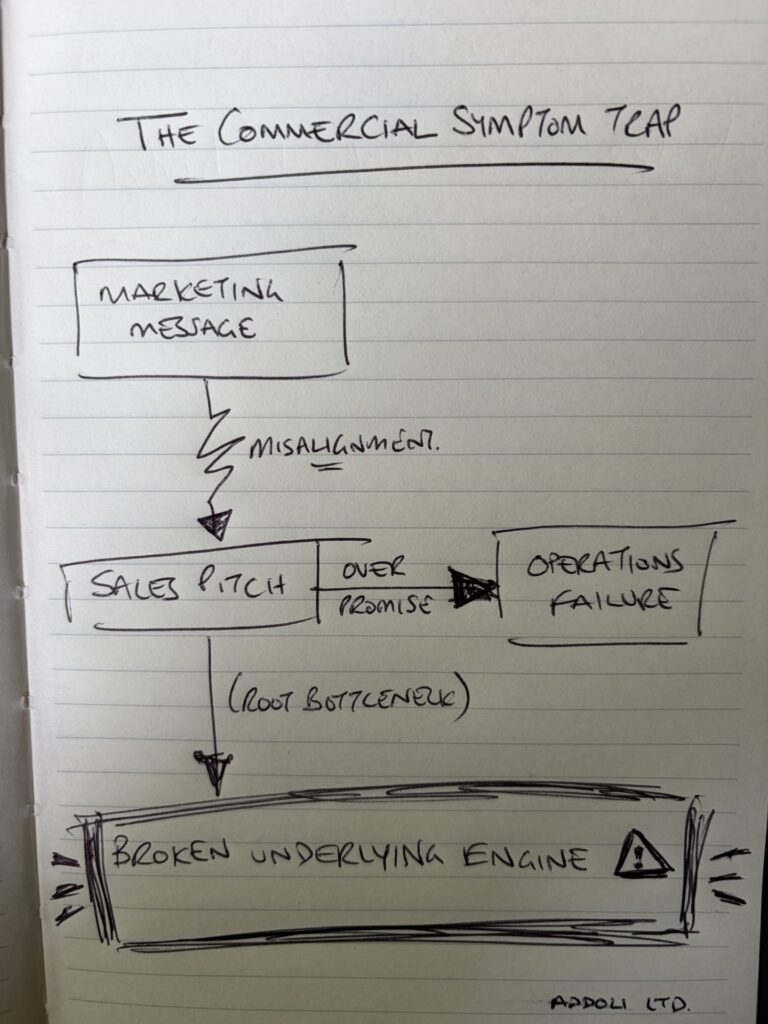
Every intervention aimed at the visible symptom leaves the sequence intact.
Realignment: open the bonnet first
Good commercial advice does not begin by changing parts at random. It begins by looking at the whole architecture from the outside in, applying three principles before any framework is built.
Listen to the vibration. Ask better questions, stand back, and hear what the data and the team are telling you. Pay equal attention to what they are not saying.
Map every stakeholder. Identify everyone who genuinely shapes commercial performance, not only the visible operating factors. Operating factors are not the same as strategy.
Unify the language. Communicate the strategy so that it lands at every level. Everyone is part of the journey, so everyone needs to understand the route.
Stop driving a misaligned car
Before you hire another salesperson, rework the marketing budget or refresh the website, pause.
Look beneath the dashboard. Check who else in the business needs to be part of the conversation. Confirm that your business model, your pricing, your delivery capacity and your sales messaging are all tracking in the same direction.
If you do not fix the underlying commercial infrastructure first, the new campaign or the expensive new hire will simply say the wrong thing with far more confidence.
Does your steering wheel shake when you try to accelerate? Have you ever invested heavily in a sales or marketing push, only to find the real bottleneck sitting somewhere else entirely?
If these structural challenges sound familiar, and you want to move your business from reactive to intentional growth without a full-time hire, let us talk.
Frequently asked questions
How do I know whether I have a sales problem or a structural problem?
A sales problem is isolated and responds to sales-level intervention. A structural problem returns as soon as pressure increases. If performance improves briefly after each new hire, campaign or incentive, and then reverts, the cause sits upstream of sales.
Is hiring a salesperson ever the right answer?
Yes, when the proposition is clear, pricing is current, delivery can absorb the volume and the messaging is consistent across the business. A new salesperson accelerates a system that already works. They cannot compensate for one that does not.
What is the founder bottleneck?
It is the point at which the business depends on the founder’s personal capacity for relationships, decisions and deals. Growth then stops at the limit of one person’s available time, regardless of how much is spent on demand generation.
What does a fractional commercial director actually do?
A fractional commercial director provides senior commercial leadership on a part-time, retained basis. The work typically starts with diagnosis of the commercial system, then realignment of proposition, pricing, sales and delivery, without the cost or commitment of a full-time appointment.