A framework by Tom Wood, founder of Addoli

The 7 Plateaus Framework

What is the 7 Plateaus Framework?

The 7 Plateaus Framework is a commercial maturity model that maps the seven growth stages a founder-led business passes through, from The Starting Line to Category Ownership. Each plateau has its own constraint, and the move that breaks one plateau keeps you stuck on another. It was developed by Tom Wood, founder of Addoli.

Overview

A diagnostic map for founder-led businesses

Most founder-led businesses don’t plateau because the founder lacks ability. They plateau because the business has outgrown what got it here, and nobody has named what needs to change next.

The 7 Plateaus Framework maps the seven distinct growth stages every founder-led business passes through. Each plateau has a specific character, a specific set of symptoms, and a specific set of things that have to be true before the business can move forward.

Most businesses are stuck between Plateau 3 and Plateau 4. Not because they’re failing. Because they’re succeeding in ways that have stopped working.

Find Out Which Plateau You Are On →

The seven stages

Introducing The Plateaus

Each plateau has its own character, its own symptoms and its own test for breaking through.

Plateau

1

The Starting Line

Proving the concept works.

Every business starts here. Revenue is irregular. Every client feels like a small miracle. The founder does everything. There are no systems yet because there’s nothing to systematise, just the constant work of figuring out whether anyone actually wants what you’re offering.

The danger at Plateau 1 isn’t failure. It’s staying here without realising it. Founders who mistake early activity for traction, who mistake occasional wins for repeatable success, spend years working hard at a hypothesis they haven’t yet validated.

You’ve broken through when: You have repeatable client success with the same type of client, producing the same type of outcome, and revenue you can roughly forecast.

Plateau

2

First Proof

Traction exists. Everything still runs through you.

You’ve proven the concept. Clients are genuinely happy. Revenue is growing. And every single important thing in the business depends on you personally. Sales depend on your relationships. Delivery depends on your involvement. Success relies on your direct effort.

This is a good plateau to be on. It means the business works. The question is whether it can work without you, and at Plateau 2 the answer is still no.

You’ve broken through when: You can acquire new clients predictably without the founder being the only reason they say yes.

Plateau

3

The Busy Trap

What is the Busy Trap?

The Busy Trap is Plateau 3 of the 7 Plateaus Framework: the stage where a founder-led business is operationally capable and the team is competent, but the founder is still in every significant decision, sales conversation and escalation, so growth is capped by the founder’s hours.

You’ve become the ceiling.

This is where most founders first feel it, when 'busy' becomes your stock answer when asked how you are. The business is operationally capable. The team is competent. Work is being delivered. And the founder is still in every significant decision, every sales conversation, every client problem that escalates beyond the team’s authority.

The ceiling isn’t market demand. It’s not the team. It’s the founder. Growth is capped at the number of hours one person can work, and that number is already maxed out.

You’ve broken through when: The business can deliver consistently without constant founder intervention. You can take a week out and things don’t fall apart.

Plateau

4

Almost There

Partial systems. Walking through treacle.

The difference between Plateau 3 and Plateau 4 is that at Plateau 4, founders know what the problem is. Some processes are documented. Some decisions get made without the founder. There’s a commercial infrastructure, it’s just incomplete. Some things are in the system. The rest are still in the founder’s head.

This is the most common plateau for £1m–£15m businesses. Strong delivery. Weak infrastructure. The founder is the system for the things that matter most. Growth is inconsistent, good quarters and bad quarters, because it depends on which parts of the infrastructure are working in any given month.

You’ve broken through when: Performance becomes systematic and reliable. Growth stops depending on heroics.

Plateau

5

The Engine Room

The business works without you.

At Plateau 5, the commercial infrastructure is genuinely in place. Systems are documented and followed. Complementary leadership exists. The founder is no longer the operational dependency. Growth is predictable. The business can handle volume without breaking.

This is not the end of the journey. It’s the point at which the business becomes a business rather than an extension of the founder. The constraint shifts from operations to positioning, from “can we deliver?” to “are we the obvious choice?”

You’ve broken through when: You’re no longer competing on price. Clients choose you for reasons competitors can’t match.

Plateau

6

The Incomparable Business

Escaping the comparison trap.

Plateau 6 is a positioning breakthrough. The business has stopped trying to be better than the competition and started being different in ways the competition can’t replicate. Premium pricing is accepted without objection. Wrong-fit prospects self-select out. The right clients arrive already half-convinced.

This is the plateau most founders aspire to but few understand structurally. It requires genuine differentiation, not marketing language, but a proposition that names a specific problem for a specific buyer at a specific moment and owns that ground.

You’ve broken through when: Competitors start following your lead. You define what good looks like in your market.

Plateau

7

Category Ownership

Defining the market you lead.

Plateau 7 businesses don’t compete for market share. They define the category. They set the standard others are measured against. They attract talent, partnerships, and acquisition interest without seeking them.

At Plateau 7, the business has an identity beyond the founder. The question shifts from “how do we grow?” to “what are we building this for?” Succession, legacy, strategic options, these become the live questions.

Most businesses reading this are not at Plateau 7. And most don’t need to be. The work is in the plateaus below it.

You’ve broken through when: The business sustains market leadership and creates enduring enterprise value that outlasts its founder.

The gap

Where Most Businesses Are Stuck

The gap between Plateau 3 and Plateau 5 is where most founder-led businesses between £1m and £15m spend years.

Not because they’re failing. Because they’re succeeding in a way that has stopped scaling. The founder is excellent. The work is strong. The clients are happy. And the business cannot grow faster than the founder can personally operate, because the founder is still the system for the things that matter most.

The journey from The Busy Trap to The Engine Room typically takes 12 to 24 months of deliberate, systematic commercial work. Not luck. Not a new hire. Not a rebrand or a pivot.

Deliberate work. In the right sequence. Built on an honest diagnosis of what’s actually missing.

Addoli 7 Plateaus Diagnostic

Free diagnostic

The Diagnostic

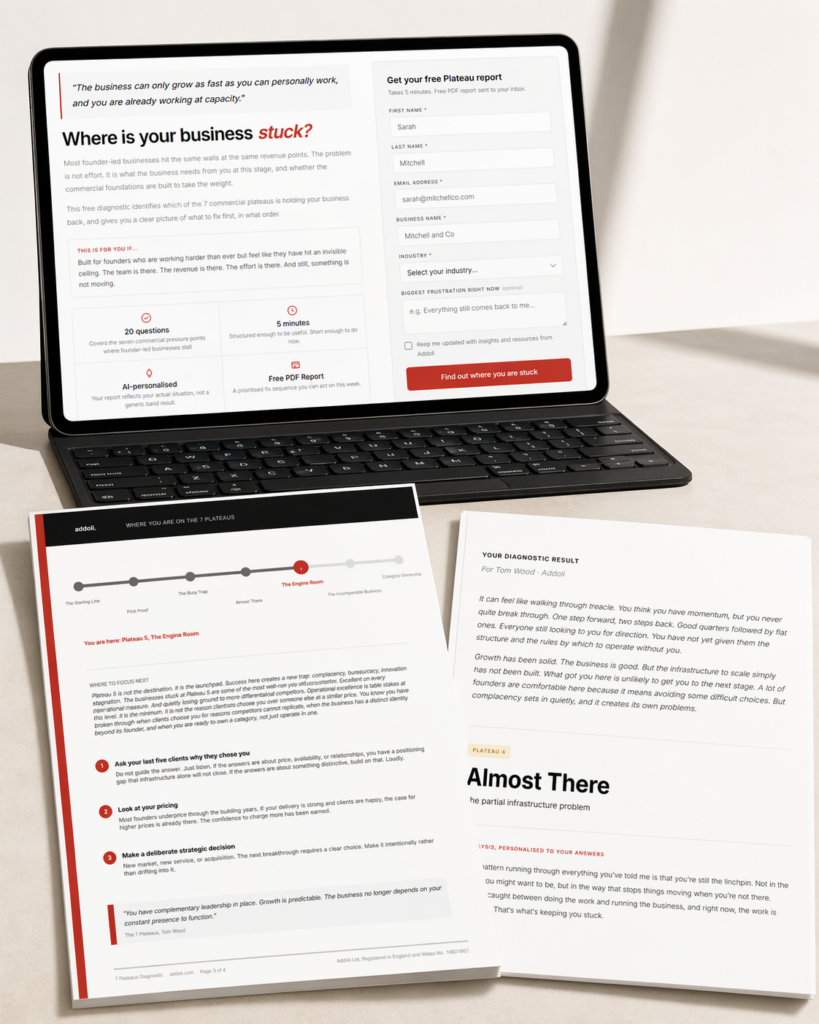
The free 7 Plateaus Diagnostic identifies exactly which plateau your business is on, and what needs to change to move through it.

Twenty questions. Five minutes. An instant result, and a personalised PDF report with guidance sent to your inbox.

It doesn’t ask how you feel about your business. It tests the structural conditions that determine which plateau you’re on, the commercial infrastructure, the decision-making patterns, the founder dependency levels, the positioning.

Most founders find it confirms something they’ve been carrying without being able to name.

Take The Free Diagnostic

A Connected Ecosystem

The 7 Plateaus Framework connects across everything Addoli produces.

01

The Book

The Plateau traces 25 years of Tom Wood’s commercial career and maps each chapter to the plateau it reflects. The framework is grounded in lived experience, not management theory.

Join The Waiting List

02

The Video Series

Seven videos, one for each plateau, designed for founders. They each cover what the plateau looks like, the traps that keep founders stuck, and what breaking through actually requires.

Watch The Series

03

The Frameworks

The 7 Plateaus maps the journey. The three 5R frameworks (Commercial Diagnosis, Commercial Infrastructure, Market Positioning) describe the work required at each stage.

Explore The Frameworks

04

The Proposition Diagnostic

For businesses stuck at Plateau 4 or 5 where positioning is the specific constraint, the Proposition Architect diagnostic scores your proposition across two frameworks and names the failure pattern.

Take The Proposition Diagnostic

05

The Newsletter

The Commercial No. 2, published every Saturday, applies the 7 Plateaus thinking to the real commercial problems founders face every week. Join hundreds of other subscribers.

Subscribe on LinkedIn
Tom Wood Addoli Fractional Commercial Director

About the framework

The 7 Plateaus Framework is proprietary to Addoli Ltd and Tom Wood.

It is not borrowed from a management textbook. It is not a repackaging of existing models. It was developed through direct experience over the last 25 years, including building a compliance consultancy and e-learning platform business to market leadership and a successful exit and merger, then spending time working alongside founders stuck at exactly the plateaus the framework describes.

The framework is free to use for personal diagnostic purposes. It is not to be reproduced, adapted, or commercialised without written permission from Addoli Ltd.

If you’d like to discuss how the framework applies to your specific business, the right starting point is the free diagnostic or a direct conversation.