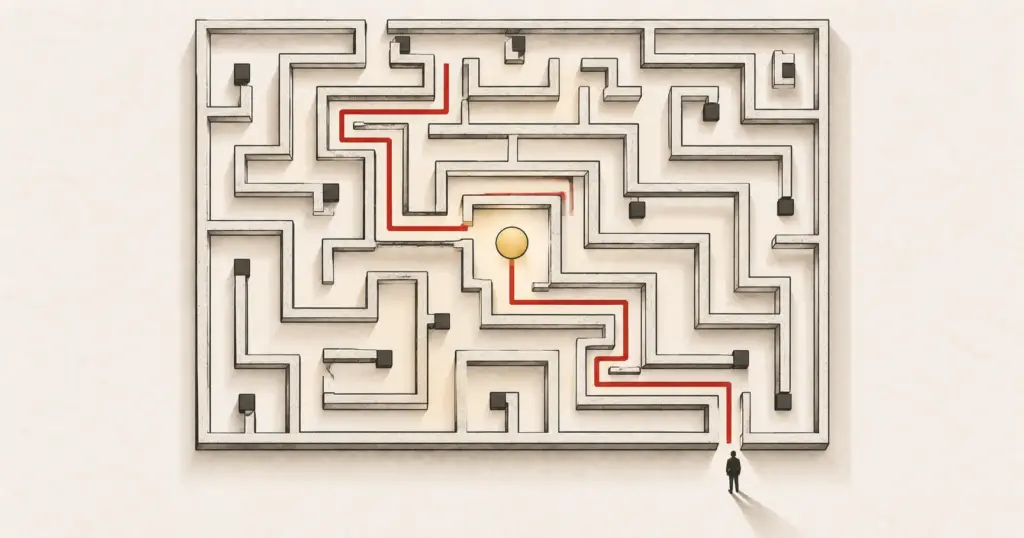
Every child knows the trick to a puzzle book maze. You do not begin at the entrance. You start at the end goal and work backwards. It is not cheating. It is the method. The end goal tells you which paths matter and which ones are dead ends dressed up as progress.
Hand a seven-year-old a puzzle book and they will work this out by the third maze. Hand a founder a growing business and they will spend years wandering corridors, taking every turning that looks like movement, without once asking the only question that solves the thing.
Where does this actually end?
Over the years, I have seen what happens when nobody asks it. Four different situations. Four different businesses. The same root cause underneath all of them, and I still see them now.
What the dead ends can look like
The promotion trap
A founder called me frustrated. Revenue down 15% and no idea why.
Their best salesperson had been promoted into a leadership role. Pay rise, new title, seat at the table. Revenue should have gone up, but it went backwards. He did not know why.
The answer: nobody had stood at the end goal. Nobody had asked what the business needed the role to actually be, whether this person was built for it, or what would fill the revenue gap the promotion created.
The salesperson did not fail. The business put them in the wrong corridor and called it a reward. Some months later they left anyway, to a competitor who put them back in a higher paid sales role. They did not leave alone.
The board that stopped reading its own reports
An ex-colleague told me that in a previous business they spent hours every month preparing board reports. Comprehensive, well structured, everything the board needed to make good decisions. Most of them arrived at the meeting having not read it.
So the meeting became a catch-up. Old ground, covered again. Time, the most expensive thing in that room, spent on what everyone should already know rather than where the business was going next.
Boards that do not read their own reports are not governing. They are attending talking shops. Looking backwards, not forwards. The path forward was in the pack. Nobody opened it.
The career structure that backed the business into a corner
The only path available was upwards. No lateral development. No remuneration growth without a title change. No honest conversation about what people actually wanted from their careers.
So the ceiling became: promote them or lose them. And when there was nowhere meaningful to promote them to, the business used that as an excuse to manage them out instead.
The maze had one route. The business built it that way and then acted surprised when good people kept hitting the same wall.
The founder with no written destination
I asked a founder what their business needed to look like in three years. They said: “Bigger and better.”
I asked about revenue, margin, team structure, what their own role would be. Nothing written down. Every version of the answer negotiable, including with themselves.
You cannot start from the end goal if you do not know where the end goal is. Bigger and better is not a destination. It is just motion with a positive feeling attached to it.
Four situations. On the surface, nothing in common. A people decision, a governance problem, a structural flaw, a strategy gap. Underneath, exactly the same thing. Nobody had started at the end goal.
The manager who solved my maze for me
I learned this lesson before I knew it was a lesson, working in what I still call the ultimate student job: a fifteen-screen cinema in Cardiff.
I loved it. The energy of opening weekends, the problem-solving when things went wrong, watching every film that came out. I was good at it, and a popular member of the team. Good enough that when a management position came up, I thought it was mine.
I did not get it. I was annoyed. My line manager was annoyed on my behalf. Then the head cinema manager pulled me to one side and said something I have never forgotten.
“I did not give you the job because you would be wasted here. You will go on to do bigger and better things. This is not for you.”
At twenty-one, that is not what you want to hear. I wanted the promotion, the recognition, the next step up. The next turning in the maze.
But he had done something I had not. He had looked at the end goal. Not the end goal of his cinema’s org chart. The end goal of my working life. And from that vantage point, the promotion I wanted was obviously a dead end. A reward that would have parked me in a corridor for years.
He solved my maze backwards because I could not see past the next junction. That is exactly what was missing in the promotion trap I described above. Nobody in the room was looking backwards from the end goal. So a reward got handed out that was really a corner, and everyone smiled while it happened.
The decision everyone said to delay
Years later, running our own business, I faced the same question at company scale.
I was invited to join a trade mission to Ireland. A chance to meet similar businesses across the border, politicians welcoming new investment, and the opportunity to examine the market for our own expansion. We already had clients operating across the border into Ireland, I had met the trade associations and the insurers, and I could see real opportunities under the Central Bank of Ireland regulator to expand our services for compliance and online learning. The case for expansion was solid.
But we were staring down the barrel of Brexit. The obvious move, the one everyone recommended, was to wait. See how it played out. Let the dust settle. Then decide.
Here is the problem with waiting. The maze was about to change shape. If we waited, the barriers would already be in place by the time we acted, and potentially we would have been locked out. Working backwards from where the world was going rather than where it currently stood, the answer was clear. Move now, while the window was open, while the networks were still fresh.
So we did. I spent a lot of time making the right connections, travelling back and forth to set up the Irish company before Brexit made it harder or impossible. The company was established, we had a foothold in Europe.
And then the pandemic stopped travel overnight, priorities shifted, our business was sold, and the Irish operation was not in the new plan, so it was shut down before we ever got properly established.
I include that ending deliberately, because this is the part most people get wrong about thinking ahead. They believe the point of planning is to guarantee the outcome. It is not. Circumstances beyond your control can still wreck the result.
The point of starting at the end goal is that you get to make the decision while you still have options. We chose to enter Ireland on our terms, early, with the window open. Events took it away from us. That makes the outcome unlucky. It does not make the decision to take that path wrong.
The businesses I described earlier did not have that luxury. They were not unlucky. They never made a decision at all. The maze made it for them.
Why this is Plateau 3 and 4 territory
In the Addoli 7 Plateaus framework, this is the signature of The Busy Trap and Almost There.
The Busy Trap
The business delivers excellent work and everything runs through the founder. Growth requires more hours, more involvement, more of you. There is movement everywhere, constant and exhausting. What there is not is a destination, because the founder is too deep in the corridors to climb up and look at the whole maze.
Almost There
It gets subtler. Some things are documented. Some decisions happen without you. It feels like momentum. But long-term thinking battles short-term pressure, and short-term usually wins. You are walking through treacle, taking turnings that look like progress, never quite breaking through.
Both plateaus share the same tell. Ask the founder what the business looks like in three years and you get a feeling, not an answer. Something about growth, maybe a number, maybe an eventual sale. Nothing written down. Nothing you could hand to a board, a leadership team, or a buyer.
And here is the uncomfortable arithmetic. Businesses that fail to think ahead always pay for it later. And they almost always pay more than the thinking would have cost.
The promotion trap costs you a good person eighteen months down the line, plus the recruitment, plus the knowledge and potentially clients that walk out the door. The board that stopped reading its reports costs you the one early warning that was sitting in the pack nobody opened. The career ladder with only one direction costs you your best operators, promoted into management jobs they never wanted. The founder with no written destination costs the most of all: every decision in the business gets made against a target that does not exist, which means every decision is really a guess.
None of these costs arrive as an invoice. That is why they are so easy to defer. There is no line in the P&L called “decisions we made without a destination.” But the money goes out all the same. It just goes out later, in worse ways, at worse moments.
The one question
There is one question that solves the maze. Founders who ask it make better decisions. Boards that ask it run better meetings. Leaders who ask it stop handing out rewards that are really dead ends dressed up as progress.
Where does this actually end?
Not a five-year vision. Not a values statement. Just an honest answer to a plain question about the maze you are currently in.
Most founders have never asked it. Not because it is hard. Because the corridors are noisy and the next junction always looks urgent.
Start at the end goal
Write down, in plain language, what the business looks like at the end of the maze you are currently in. Not forever. Just this maze. Three years is usually enough. What it earns, what it sells, who the key stakeholders are, who is your ICP, who runs it, what your role is, what the potential risks and opportunities might be, what happens if you are hit by a bus.
Not a forty-page business plan that simply aims for 20% year on year growth and the associated expenditure. That is pure guesswork with a contents page. A plain, honest answer to a plain, honest question.
Then hold every decision up against it. The promotion, the board agenda, the career structure, the next hire. Does this turning lead towards the end goal, or does it just feel like random movement?
Most founders have never done this exercise, or if they have, it only fits on the back of a beer mat. Not because it is hard. Because the corridors are noisy, the next junction always looks urgent, and nobody is standing where that cinema manager stood for me: at the end goal, looking back.
Everyone knows how to solve a maze. You start at the end goal and work backwards.
The expensive mistake is believing your business is the exception.