If I asked a room of founders in October who already has a business growth plan for 2027, I would not expect many hands to go up. Most are still running hard at 2026. The quarter is busy, clients want work finished before Christmas, and planning feels like a job for a quieter week.
The quieter week never comes. Then it is January, and the first quarter of the new year goes on working out what the year is for.
Planning is the founder job that gets squeezed out first, because nothing is on fire. That is exactly why it matters.
Key takeaways
- The decisions that shape next year are made, or left to default, in the last few months of this one.
- A useful growth plan fits on two pages and is written to be used by the leadership team, not approved by a bank.
- Attach a £, # or % to three objectives, pull two or three levers hard and write a stop list so the plan does not become extra work.
Why should a founder plan for next year now?
Because the choices that shape 2027 are made, or not made, before this year ends. Prices for next year, the clients you choose to grow, the hire you need in place by spring, the service you should stop selling. If none of these is decided by December, each one is decided by default.
Most founders do have a plan. It lives in their head. A plan in your head cannot be shared, tested or followed by anyone else, and a team cannot pull in the same direction if nobody has told them which direction it is.
If growth already feels stuck, why your growth has stalled covers the wider picture. This post is about the plan itself.
What makes a business growth plan different?
Many founders have written a business plan at some point, usually for a bank, an investor or a grant application. It was written to be approved, not to be used.
| Feature | Plan for the bank | Business growth plan |
|---|---|---|
| Purpose | Written to be approved | Written to be used |
| Length | Twenty pages of forecasts | One or two pages of choices |
| Content | Says what will happen | Says what we will do differently |
| Use | Read once, then filed | Reviewed every quarter |
| Owner | The founder | The leadership team |
The plan you need for 2027 is the second kind. It is short, it makes choices, and it tells everyone which levers you are going to pull.
Who does the plan have to work for?
Every business depends on a small number of key stakeholders. For most founder-led B2B businesses there are three or four.
- Owners. You, and any partners or shareholders. What do you want from the next few years: more time, more income, a business that runs without you, a clear end goal? If there are other owners, check they want the same thing. Often they do not, and nobody has said so.
- Employees. Your leadership team and the people who deliver the work. What do you need the leadership team to own, and what do they need from you? What would make your best people stay and grow?
- Customers. Not every client, only the ones you want more of. What will your best-fit clients need from you next year that they do not get now?
- Suppliers. Only where the relationship is strategic, such as the associates, subcontractors or partners you could not easily replace. If you could swap them next month, they are not a key stakeholder.
Not every group that touches the business qualifies. A group counts only if it has a fundamental effect on performance, you can say clearly what you want from it, the relationship is changing, you could not easily replace it, and it is not already counted under another group. That is why the leadership team sits within employees, and a business partner sits within owners.
For each key stakeholder, ask yourself three questions:
- What do I want them to do next year, and what do they want from me?
- Have I asked them, or have I assumed?
- Where do the answers pull in different directions, and which differences will cause trouble if nobody deals with them?
The gaps between what these groups want are where most plans go wrong. Find them in October, not in March.
The businesses that have a good year rarely got lucky in January. They made their choices in October.
Tom Wood
What should the plan commit to?
Start with how you make money today
Before you decide where to grow, be clear about where the money comes from now. Which services and which clients make you the most profit, not just the most revenue? Which ones take the most effort for the least return?
This is usually where the surprises are. A service the founder loves can quietly lose money. A small client can turn out to be the most profitable one you have.
Set three objectives, not ten
An objective names what you want a key stakeholder to do, and carries a £, # or % you can track. “Grow revenue” is a wish. “Increase recurring revenue from 20% to 50% of the total” is an objective.
A revenue figure on its own is a target. It tells you the size of the prize, not what has to change to win it. So start with the behaviour you want from one of your key stakeholders, then attach the number:
- Customers: win three new clients in a new sector (#).
- Customers: move half our revenue onto recurring work (% of total revenue).
- Employees: the leadership team carries 20 hours a week of delivery that the founder does today (# hours).
For each objective, write down today’s figure, the figure you want by December 2027 and who owns it. If you cannot attach a £, # or % to it, it is not yet an objective. Keep asking until you can.
Choose two or three levers
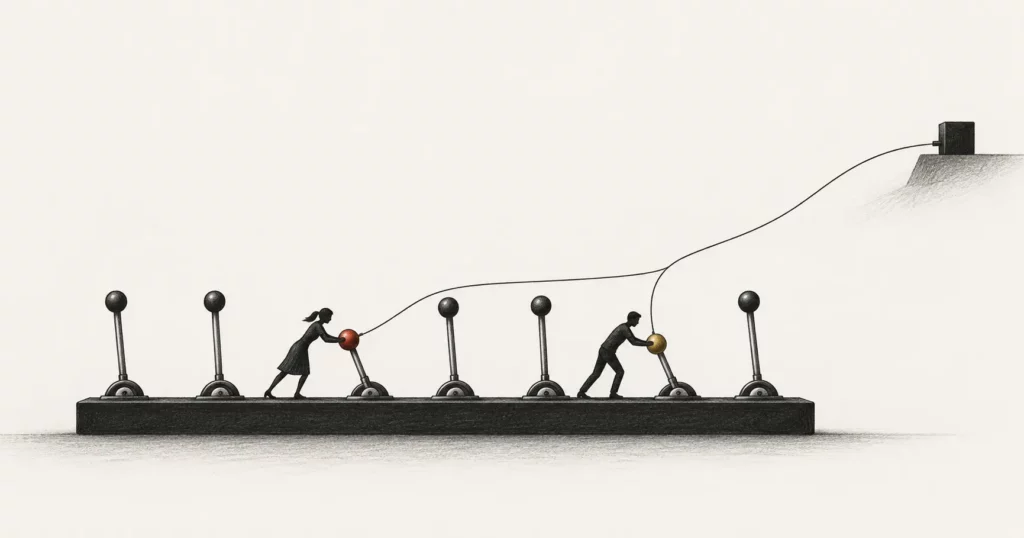
Only a handful of levers create meaningful growth. Most businesses try to pull all of them a little. A business growth plan picks two or three and pulls them hard.
- Price. Are you charging for the outcome, or for the hours?
- Client mix. Could you do more work for the clients who suit you best, and less for the ones who do not?
- Existing clients. Is there more you could do for the clients you already have?
- Proposition. Would the right buyer recognise themselves in how you describe what you do? If not, read why your proposition is losing ground.
- Capacity. Can you deliver more without the founder becoming the bottleneck?
- Pipeline. Is there a reliable way of finding new clients that does not depend on your network? This is the heart of commercial infrastructure.
- People. Is there one hire, or one role handed over, that would free up everything else?
Choose the levers that would make the biggest difference to your three objectives. Then write down what you will do on each, and by when.
Write a stop list
Every plan needs a stop list: a service you will no longer sell, a type of client you will no longer take, a meeting that no longer earns its place. Without one, the plan becomes extra work on top of everything you already do.
How to draft your plan before December
You do not need a planning away day. You need two hours and an honest conversation.
- Write down what you want. Before anyone else’s view, be clear about your own. Where do you want the business, and your role in it, to be by the end of 2027?
- Ask your key stakeholders. Three questions each: what is working, what is not, and what do they need next year? Listen more than you talk.
- Draft three objectives. One line each, naming the stakeholder, the £, # or % measure, the December 2027 target and the owner.
- Pick your levers. Two or three from the seven above. Not all of them.
- Write the stop list. At least one thing.
- Put four dates in the diary. One review each quarter.
If it does not fit on two pages, you are trying to do too much. And a business growth plan that is never looked at again is not a plan.
In practice
Take the seven levers and answer one question: if you could pull only one of them hard in 2027, which would it be? Write that lever at the top of a blank page, then add the one objective it serves and the one thing you will stop to make room for it. If that page is hard to fill, you have found where the planning work needs to start.
This is the same ground I cover at the start of any work with a business, including the Commercial Diagnostic: understand the business model, the key stakeholders, the objectives and how the business makes money today, before anything gets built. It feels slow. It is where most of the gaps and the opportunities show up, before anyone has spent a penny on the wrong fix.
Frequently asked questions
When should a founder start planning for next year?
Start in October or November, before the year ends. The decisions that shape next year, such as prices, which clients to grow, the hire you need by spring and the services to stop, are made in the last few months of this one. If they are not decided by December, they are decided by default, and the first quarter goes on working out what the year is for.
How long should a business growth plan be?
One or two pages. A business growth plan should cover your key stakeholders, three objectives, how you make money today, the two or three levers you will pull and a stop list. If it does not fit on two pages, you are trying to do too much. The real test is not length but whether the leadership team uses it every quarter.
What is the difference between a target and an objective?
A target is a number; an objective is a behaviour with a number attached. A revenue figure tells you the size of the prize, not what has to change to win it. An objective names what a key stakeholder will do, such as moving half your revenue onto recurring work, and carries a £, # or % measure, today’s figure, a target date and an owner.
Who are the key stakeholders in a founder-led business?
For most founder-led B2B businesses there are three or four: owners, employees, customers and, where the relationship is strategic, suppliers. A group counts only if it has a fundamental effect on performance, you can say what you want from it, the relationship is changing, it is hard to replace and it is not already counted under another group.
How often should you review your plan?
Once a quarter. Put four review dates in the diary when you write the plan, so the leadership team checks progress against each objective, confirms the levers are being pulled and makes sure the stop list is holding. A plan that is read once and then filed behaves like a plan for the bank, however good it looked in December.