A founder said this to me recently: “Some years we fly. Some years we stall. Some we go backwards. I can’t always explain why.” It struck a chord, because it describes founder-led growth in so many of the businesses I work with.
It also struck a chord because the government has now published data showing this founder is far from alone. Growth is lumpy, forecasts are unreliable, and very few businesses grow every single year.
The pattern behind it is usually a capacity problem, not a capability problem.
Key takeaways
- Sustained growth is rare, so a lumpy few years is normal rather than a sign that the founder is failing.
- Founder-led growth stalls when the founder is the only engine, because the constraint is capacity, not capability.
- Planning each step up, sharing the workload and bringing in a senior second person turns a dependency into a growth engine.
How rare is sustained growth?
Each year the UK government publishes its Small Business Survey. The 2025 panel report is the one worth reading, because it tracks the same businesses from 2022 to 2025 and asks them the same questions each time. That gives you four years of real firms growing, stalling and recovering, rather than a single snapshot.
Three findings stood out.
- Sustained growth is rare. Of the firms with 10 or more staff that were growing in 2022, only 1 in 8 kept growing in every year to 2025. That is 53 businesses out of 427.
- Growth goes backwards and forwards. Nearly half (47.1%) of the businesses that cut staff in 2024 were hiring again a year later.
- Forecasts are a coin toss. Of the businesses that expected turnover to grow, only 56.7% saw it grow. The rest stood still or went backwards.
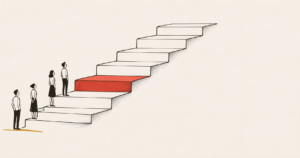
Growth is not a straight line, and it does not compound neatly. It comes in steps, and then it pauses. If your last few years look lumpy, you are in good company.
One caution. The government says the panel is not fully representative of every small business, so treat these figures as strong signals rather than rules.
Why does founder-led growth stall?
In most businesses turning over £1m to £15m, the founder personally drives every good year. They spot the opportunities, push the deals over the line, hold the key relationships and keep every plate spinning.
In a good year, that is a strength. The founder has the energy and the time, the right clients turn up, and the business flies.
But growth that depends on one person rises and falls with that person. A big client project swallows their time, so new business dries up. They make a hire and spend six months managing instead of selling. Something at home takes their attention.
Nothing is wrong with the business on paper. The engine is one person, and one person cannot run flat out every year. That is what I mean when I say your business might not be stuck. You might be.
The result is predictable. Growth stalls, blind spots appear, opportunities get missed and competitors move faster, because they have built a team that can see round corners.
If we are honest, it is often when the business stops being fun as well. I cover the wider causes in why your growth has stalled.
The founder ceiling is not usually capability. Most founders are more than capable. It is capacity. There are only so many hours, and the business has outgrown them.
In the 7 Plateaus framework, this is Plateau 3, The Busy Trap. Revenue has outgrown what the founder can carry, but everything still runs through them.
If the founder is the only person who knows how next year grows, the business does not have a growth engine. It has a dependency.
Tom Wood
Who carries the next step up?
A reader made a good point: the businesses that handle lumpy growth best plan for the steps up before they arrive, rather than reacting once they are already stretched.
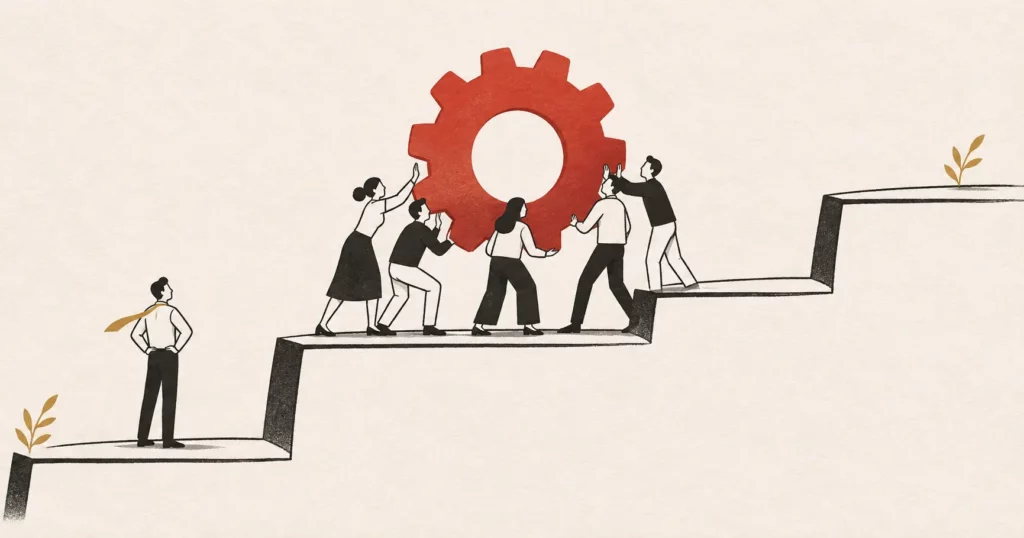
I would go further. A step up is not only about money. It is about who carries the next stage.
Every step asks the business to do something the founder cannot do alone: run a bigger pipeline, price more deals, manage more people, hold more relationships. If the founder is still the only person who can do those things, the step up becomes a stall.
The same survey suggests more founders are acting on this. In 2023, 75% of SME employers had no director running the business day to day who was not an owner. By 2025, that had fallen to 62%.
That is a 13-point shift in two years. More founders are bringing in a senior person who is not them to help run the business. In my experience, it usually happens for one reason: doing it alone stopped working.
The gap between founder energy and repeatable commercial growth is where a senior second person, a Commercial No. 2, earns their place. For the timing question, read when you should hire a commercial director.
What kept growth going for 13 years?
At RWA, we grew year on year for 13 years. Given how rare sustained growth is, I know that is unusual.
It was not luck, and it was not one person working harder than everyone else. It came down to four habits we shared as a leadership team.
Plan for growth
We did not wait for the next step to arrive and then scramble. We decided where we were going and what it would take to get there.
Talk about progress
We talked about progress often enough to notice when something was drifting, while there was still time to put it right.
Choose the right objectives
We agreed a small number of things that mattered, together, rather than keeping a long list in one person’s head.
Share the workload
The right skills worked on the right tasks. Nobody carried everything.
That last habit is the difference between capability and capacity. Every one of us was capable. Growth kept going because none of us was the only engine.
What can a founder do this month?
You can start building the same habits before you have a team around you. You need an hour and some honesty.
In practice
Draw your own four years. For each of the last four years, write whether turnover grew, stayed flat or fell. Next to each one, write what you personally spent most of that year doing: selling, delivering, hiring, firefighting or recovering. In most founder-led businesses, the good years line up with the years the founder was selling.
Then work through four more checks.
- Count where your deals came from. List every new client or contract from the last 12 months and mark the ones you personally found, pitched or closed. If it is most of them, your growth has a single point of failure.
- Run the two-week test. If you disappeared for two weeks, what would happen to sales? Not delivery. Sales. If the honest answer is “nothing new would come in”, you have found your constraint.
- Write the job description for the person you do not have. If you brought in a senior commercial person tomorrow, what would they own? Write down the decisions, the relationships and the numbers. Most founders find they cannot write it, because it all lives in their head. That is the first thing to fix, whoever ends up doing the job.
- Plan for the next step before it arrives. Pick the next jump you want: a bigger client, a new market, a new service. Then ask what would need to be true about people, pipeline and pricing for it to land. If the answer is “I will just work harder”, that is the stall waiting to happen.
Is a stall random or predictable?
A stall is not random weather. In most of the businesses I work with, founder-led growth stalls when the next stage of growth still depends on one person.
More founders are working that out. The question is whether you work it out before the next stall, or during it.
If this feels familiar, it is probably not a sales problem or a marketing problem. It is probably a capacity problem, and that is very fixable.
Frequently asked questions
Is a stall in growth a sign that the founder is failing?
No. A stall usually means the business has outgrown what one person can carry. Most founders are more than capable. The government panel data shows that growth moving in steps, with pauses between them, is the normal pattern rather than the exception, so a lumpy few years does not point to personal failure.
How do I know if my business depends too heavily on me?
Run the two-week test. Ask what would happen to new sales if you disappeared for two weeks. If nothing new would come in, growth depends on you. A second check is to list the clients you personally found, pitched or closed in the last 12 months. If that is most of them, you have a single point of failure.
What is a Commercial No. 2?
A Commercial No. 2 is a senior commercial person who works alongside the founder and owns part of the growth engine, such as pipeline, pricing and key relationships. They help the business grow without every decision running through the founder. In a smaller business this is often a fractional role, working one to two days a week.
When should a founder bring in a senior commercial person?
Bring one in when the next step up needs skills or time the founder cannot supply alone, such as running a bigger pipeline, pricing more deals or managing more people. Make the decision before the stall rather than during it. Planning the step in advance gives the new person time to settle in before the pressure arrives.