
Why does accountability without authority stall founder-led growth?
Accountability without authority stalls growth because a founder gives a new hire the job title but keeps the decisions. The hire owns the result but must ask permission to act, so they act less, the client grows unsure who to call, and growth stays capped at the founder’s hours. It shows up as three moments: the gate, the late jump and the quiet swap.
New here? Start with these
The three ideas everything else builds on
 01 · Where you are
The 7 Plateaus: where is your business stuck?
The seven stages every founder-led business moves through, and the ceiling at each one.
 02 · What to build
What is commercial infrastructure?
The systems that let revenue grow without the founder at the centre of every decision.
 03 · Who builds it
What is a Fractional Commercial Director?
Senior commercial leadership one to two days a week, and when it is the right move.

Why Prospects Keep Comparing You on Price (And How to Make It Stop)
Prospects keep comparing you on price because of capability-first positioning: when competing firms all describe what they do, the prospect has no basis for comparison except price. The fix is issue-led positioning, which leads with the specific problem the buyer is trying to solve, names the cost of leaving it unsolved and explains how you resolve it. Pricing pressure then reduces because the comparison becomes harder to make.

Why You Are Still In Every Sales Conversation
Founders stay in every sales conversation because the commercial system was never built, so the problem is structural, not a quality or people issue. Without clear positioning, a qualification framework and a commercial rhythm, the team defaults to the founder and new hires fail. The cost is stalled deals, evenings and weekends lost, and a business that stays stuck. The fix is to diagnose what is being held, build that infrastructure, then withdraw deliberately.

The Business Case for a Fractional Commercial Director
For a founder-led B2B business turning over £1m to £15m, a Fractional Commercial Director is usually worth it. It costs around a quarter of a full-time hire in year one, starts delivering in the first month and leaves behind systems the team can run without them. The stronger argument is not the saving. It is what waiting costs.

What I Learned Rebuilding the Training Solution I Once Disrupted
After more than 15 years building e-Learning platforms, in 2022 I was asked to transform a traditional training company just as the pandemic had stopped classroom training. Two years inside showed me that classroom learning builds confidence and community, but cannot survive on legacy methods alone. The answer was to blend human interaction with digital access. The lesson is to make competence measurable, focus on skills rather than courses, and embed learning into work.
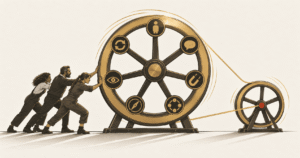
The Lead Gen Flywheel: Boost Your Marketing Campaigns
Structuring campaigns around the Lead Gen Flywheel replaces start-stop linear marketing with a continuous system in which each campaign compounds the last. It forces clarity on one person, one problem and one promise, then uses the insights, performance data and refined messaging from each campaign to power the next rotation. The result is marketing that generates learning as well as leads, and builds momentum instead of starting from scratch.

Why Smart Leaders Get Stuck (And How to Get Unstuck)
Smart leaders get stuck because what worked getting the business to £1m to £2m does not work at £15m, so they keep doing what they know, just harder, until the founder becomes the constraint. Most plateau problems are clarity problems, not motivation problems. Getting unstuck takes three shifts: from vague to specific, from infinite capacity to ruthless prioritisation, and from founder-dependent to system-dependent.

Introducing Stakeholder Mapping: The Must Have Strategy Tool
Stakeholder mapping is a structured way to plot the groups that have a fundamental impact on performance, such as customers, employees, suppliers and investors, and to set the few things you must get right for each. It is a must-have strategy tool because it separates strategy from operations, focuses scarce effort and builds measurable objectives, using one set of success factors per stakeholder group rather than one generic list.

A New Approach to Compliance Risk Management: Creating Data-Driven Compliance Tools
As FCA scrutiny grew, compliance reviews built in long spreadsheets were slow, static and subjective, and firms could not measure improvement or benchmark against peers. We designed a suite of data-driven, FCA-aligned tools: digital healthchecks with automated risk scores, benchmarking dashboards, board reporting templates and consultant analytics. Clients could show the FCA how they found and fixed risks, consultants did less manual work, and client retention improved. Data does not replace expertise; it amplifies it.

Building a culture blueprint: The starting point for growth
After two competing consultancies merged, the teams brought different cultures, expectations and processes, with a real risk of duplication and tension. Working with the MD through workshops, interviews and feedback sessions, we built a Full Cultural Blueprint covering leadership structure, reporting cycles, decision rights and communication, and staff wrote their own Staff Charter. Within three months the team worked as one, decisions were faster, and staff and client attrition plummeted.