
Why is my website attracting the wrong prospects?
You are attracting the wrong prospects because your proposition tells everyone they are welcome. When a page does not say who it is for, the wrong buyers enquire and the right buyers quietly leave without contacting you. A clear fit line, including who you are not for, filters out the wrong enquiries and gives the right buyers confidence to get in touch.
New here? Start with these
The three ideas everything else builds on
 01 · Where you are
The 7 Plateaus: where is your business stuck?
The seven stages every founder-led business moves through, and the ceiling at each one.
 02 · What to build
What is commercial infrastructure?
The systems that let revenue grow without the founder at the centre of every decision.
 03 · Who builds it
What is a Fractional Commercial Director?
Senior commercial leadership one to two days a week, and when it is the right move.
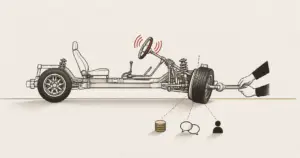
The commercial symptom trap: another salesperson isn’t a fix
Another salesperson is rarely the fix, because stalled revenue is usually a structural problem, not a sales problem. Sales and marketing are the vibrating steering wheel: the first places a deeper misalignment shows up, typically a proposition gap, a communication chasm or the founder bottleneck. Fixing the symptom simply drives a misaligned business faster. Diagnose the commercial system from the outside in before you hire, spend or rebrand.

The second ledger: why the best commercial decisions never show up on a spreadsheet
The best commercial decisions never show up on a spreadsheet because their return lands on a second ledger that never gets opened: loyalty, reputation, sustainability and trust. The first ledger only shows the cost, so the cheaper option always looks disciplined. The second ledger holds value that compounds but is impossible to prove in advance, so it rarely gets funded. Businesses that break through their plateau learn to read it anyway.

What Is Commercial Infrastructure? A Plain-English Definition
Commercial infrastructure is the set of documented, repeatable systems that allow a business to generate revenue independently of its founder. It has five components: positioning, sales process, pipeline system, pricing architecture and playbooks. Without it, a business can only grow as far as the personal capacity of the founder, which is why most founder-led businesses plateau between £1m and £15m.

The Two Questions That Get Founders Unstuck
The two questions are “What if I do not do it?” and “Can you control it?” The first replaces “Will I regret this?”, a backward-looking question that paralyses decisions, by making founders look at the real cost of standing still. The second eases stress: if you can control it, plan and act; if not, accept it and let it go. Both stop founders spinning on things they cannot change.
Why Did Your Sales Hire Fail? The System Problem Nobody Diagnoses
Most sales hires in founder-led businesses fail because the business has no commercial infrastructure for them to execute against, not because the wrong person was hired. Without documented positioning, a sales playbook and a pipeline system, the hire inherits a role only the founder could ever do, because only the founder carries the knowledge it depends on. Build those three things first and an average salesperson performs well.

The Absence Test: What Your Business Does When You Are Not There
You stop being the bottleneck by building a business that does not need you in the room, then leaving the room. That means decisions with owners who are not you, commercial processes that live outside your head, and a team given real responsibility with real outcomes attached. Hiring better people does not fix it on its own. The test is simple: what happens to your business when you are away for two weeks?

Fractional vs Consultant vs Coach: What Is the Real Difference?
The real difference is ownership. A coach helps you find your own answers, a mentor shares experience, a consultant diagnoses and recommends while implementation stays with you, and an advisor is a sounding board over time. A fractional director runs the commercial function, or a significant part of it, on a part-time basis and is accountable to what actually gets built. Before choosing a label, ask what the job actually needs to be.
Trust Isn’t a Value. It’s an Architecture.
Trust is not something you state in a values deck. It is something you build, decision by decision, into how the business runs: who can decide what without asking, and whether good judgement is used or routed back to the founder. Built properly, consistent and trusted service becomes commercial infrastructure and a sellable differentiator. AI does not change this; it removes the cover.

Why Buyers Compare You on Price (and How to Make Them Stop)
Buyers compare you on price because your proposition has not given them any other way to choose. This is the Comparison Trap: when differentiation is weak, price becomes the only variable left and the cheapest option wins by default. It is a positioning problem dressed up as a pricing problem. To make it stop, lead with the problem the buyer has, get specific, narrate your proof and name your method.